
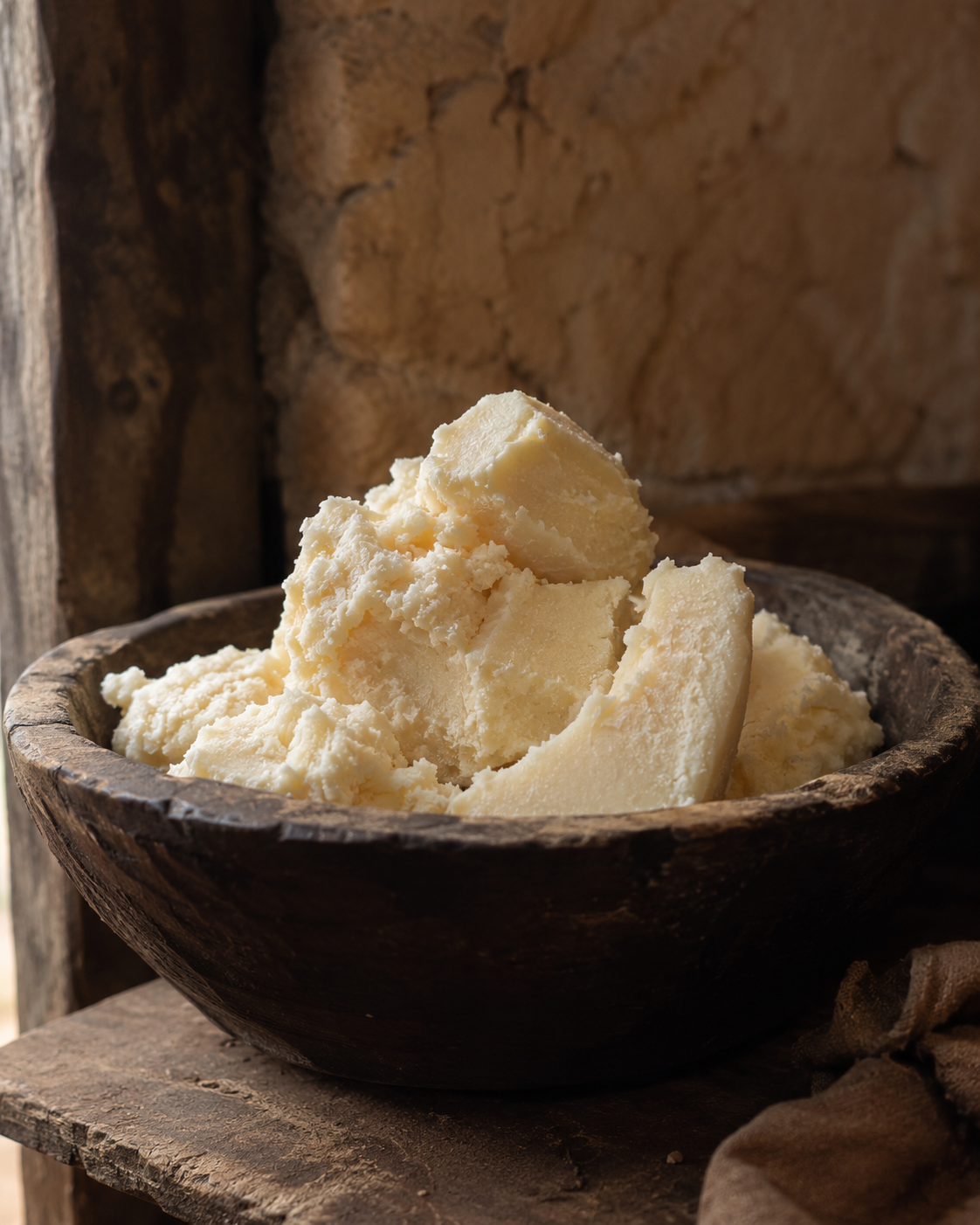
When historians talk about the wealth of ancient West Africa, they almost always reach for gold. Mansa Musa’s legendary pilgrimage to Mecca in 1324; during which he reportedly dispensed so much gold that he crashed the Egyptian economy, has become the defining image of West African prosperity. But there was another substance moving through those same trade arteries, one that in the logic of daily survival commanded a value that gold simply could not match.
You cannot eat gold. You cannot heal a wound with it, waterproof a roof with it, feed an infant with it, or light your home with it. Shea butter could do all of these things. And that is precisely why it was not merely valuable; it was indispensable.
The Scarcity Nobody Talks About
Gold’s value rests on one pillar: rarity. Shea butter’s value rested on something far more powerful; a combination of rarity and irreplaceability.
The shea tree grows naturally only in the dry savannah belt of West Africa, stretching from Senegal in the west to Sudan in the east and onto the foothills of the Ethiopian highlands. This narrow geographic corridor; dictated entirely by specific soil conditions and rainfall patterns, meant that communities outside the shea belt had no alternative, no substitute, and no way to produce this resource themselves. They had to trade for it.
Gold could be found in several locations across the ancient world. Shea butter came from one particular ribbon of earth, and from nowhere else. The kingdoms that sat within the shea belt were not merely agricultural societies; they were custodians of a biological resource that could not be replicated anywhere on earth. The utilisation of shea butter as a food oil dates back at least 3,000 to 4,000 years, giving it a production history longer than the Roman Empire.
The Tree That Would Not Be Rushed
There is another dimension to shea’s value that the gold comparison misses entirely: time. Gold, once a deposit is found, can be extracted in weeks. The shea tree does not work on human schedules.

The shea tree does not flower until it is 20 years old and only reaches maximum productive capacity at the age of 50, then remaining fully productive for more than 100 years. Think about what that means economically. A shea tree planted today will not reach its peak output until the person who planted it is long dead. Every jar of shea butter produced in antiquity represented not just labor, but multigenerational stewardship; a community’s commitment across decades to tend a tree their grandparents planted and their grandchildren would harvest.
This made the shea tree a form of living inheritance. To damage or destroy one was not merely vandalism; it was the destruction of future wealth stretching a century forward. The shea tree is considered sacred in many communities, and cutting it down is frowned upon; harvesting the nuts is governed by local customs that emphasize sustainability and respect for nature. This was not superstition. It was rational, long-term economic policy embedded in cultural law.
The Name Itself Whispers Sacred
The very language surrounding the shea tree reveals how ancient people perceived it. The word “shea” derives from the Bambara language of Mali, in which “sii” means sacred. The French name, “karité”, derives from the Wolof word “ghariti”, meaning “the tree of life.” These were not poetic embellishments. They were precise descriptions of a tree around which entire economies and cosmologies were organized.

The northern Ghanaian city of Tamale etymologically derives its name from the Dagomba word “Tama-yile”, meaning “Home of Shea Nuts.” A city named after a commodity. Imagine a medieval European city called “Home of Gold Coins”, that is the level of cultural centrality we are talking about. Shea butter did not merely support life in these communities. It defined them.
A Monopoly Enforced by Gender, Sustained by Ritual
Here is the aspect of shea’s history that receives almost no serious economic analysis: the processing and distribution of shea butter was almost exclusively controlled by women, in a world where almost no commodity was. This was not coincidence. It was an enforced monopoly backed by spiritual authority.
Men were strictly forbidden to lay a hand on the shea tree. Only women were allowed to collect its fruits and nuts, as the tree was believed to encompass mystical powers. This prohibition meant that every gram of shea butter produced in ancient West Africa passed through female hands. Women controlled the harvest, the processing, the pricing, and the trade networks.

The processing and production of shea butter is an ancient practice passed down from mother to daughter, and the sales of the butter provided economic opportunities for women and girls in shea-producing countries. In a historical context where women in most of the world had little to no independent economic agency, West African women commanded a resource that entire empires traded for. The spiritual prohibition on male involvement was, functionally, the world’s earliest documented gender-based trade cartel and it lasted millennia.
The harvesting of the fruits was embedded in an ancient ritual called Begu, rung in with a festival at which drink offerings and the slaughter of a chicken beneath an ebony tree formed the high point, and the fat from the first nuts collected was used to make a communal dish eaten by the entire village. This ritual did more than mark a harvest season. It bonded the community to the tree, prevented over-harvesting through reverence, and created a shared memory of abundance that sustained the knowledge across generations.
The Commodity That Did Everything Gold Could Not

To understand why shea butter rivaled gold in practical value, consider what it actually did. The list is extraordinary.
It fed people: Shea butter served as the primary cooking fat across the savannah belt. It was vital to daily existence, used to enhance the taste, texture, and digestibility of the major regional dishes. Gold cannot feed a family through a dry season.
It healed people: Traditional healers used shea butter for centuries to treat patients, birth mothers, and infants, and for spiritual cleansing. Applied to wounds and burns, in a world without pharmaceutical infrastructure, a fat-rich, anti-inflammatory substance meant the difference between survival and death from infection.
It built and protected homes: Shea butter was used as a waterproofing wax. Applied to roofs, leather, and wooden implements, it extended the life of every structure and tool it touched.
It accompanied the dead: The funeral beds of West African kings and queens were carved from the noble wood of the shea tree, while the butter was ritualistically coated over their bodies for burial. It accompanied rulers into the afterlife. In Ghanaian households, shea butter plays an essential role in naming ceremonies, weddings, and funerals, and babies are massaged with it for good health and skin protection. From birth to burial, shea butter marked every significant human passage.
It literally lit the night: Shea butter was used for candle-making.
It kept music alive: Shea butter was used by makers of traditional African percussion instruments to increase the durability of wood in carved djembe shells, dried calabash gourds, and leather tuning straps. Even music depended on it.
Gold, for all its glitter, could do none of this.
Ibn Battuta Noticed What Others Missed

The Moroccan scholar and explorer Ibn Battuta, who traveled through West Africa in 1354, was perceptive enough to notice that shea butter occupied a special position in the regional economy. Shea was first documented as a high-value commodity in regional trade across West Africa as early as 1354 by Ibn Battuta. His account predates European contact with sub-Saharan Africa by over a century, which means the shea trade was already mature, organized, and sophisticated long before any outside observer thought to document it.
In the great trans-Saharan trade routes that connected North and West Africa, the Middle East, and Europe; the same routes that carried gold and salt; shea butter was a regular export commodity alongside textiles, ivory, and precious stones. It moved on the backs of the same camel caravans that carried gold northward. In the ledger of trans-Saharan commerce, shea butter was not a footnote. It was a chapter.
The Colonial Blindspot That Erased Its Legacy
When European colonizers arrived and began cataloguing West African resources, they made a revealing error. They saw gold and immediately understood it. They saw shea butter and, initially, dismissed it.
When French and British colonies began exporting shea nuts and butter to Europe in the early 1900s, the exports were sold for as little as a sterling per ton in Liverpool because a mass market did not exist for it outside Africa. Europeans had no cultural framework for understanding a substance that was simultaneously food, medicine, building material, and ritual offering. Their markets were organized around single-function commodities. Shea butter was the opposite; a substance so thoroughly woven into the fabric of daily life that its value could not be compressed into a single price tag.
The irony is sharp. The shea tree gained international significance in the 1970s when it was identified as one of six plant species whose vegetable fat could substitute for cocoa butter in chocolate production and serve as a key ingredient in pharmaceutical and cosmetics industries. The West spent the better part of a century trying to decode a substance that ancient West Africans had already mastered for four thousand years.

The Deepest Lesson
What shea butter reveals about ancient West African civilization challenges the entire framework through which we typically measure historical wealth. Wealth, in the Western imagination, tends to mean surplus; hoards of gold, stockpiled treasure, accumulated abstraction. But there is another form of wealth: sufficiency distributed across an entire community, encoded in living trees, protected by ritual, carried forward by women, and applied to every moment of human life from birth to death.
Ancient movement and exchange between people in West Africa were not only about gold and salt. They were about quieter, stranger, more enduring currencies; the ones that kept children alive through the harmattan season, softened the joints of elders, lit the darkness, sealed rooftops against rain, and anointed the bodies of kings.
Shea butter was worth more than gold in ancient West Africa for the simplest possible reason: gold was precious, but shea butter was necessary. And in the calculus of survival, necessity has always outranked beauty.
The next time you reach for a jar of shea butter, remember that you are holding something older than most religions, more traveled than most explorers, and more valued; in the truest sense of value than the gold that history chose to remember instead.