
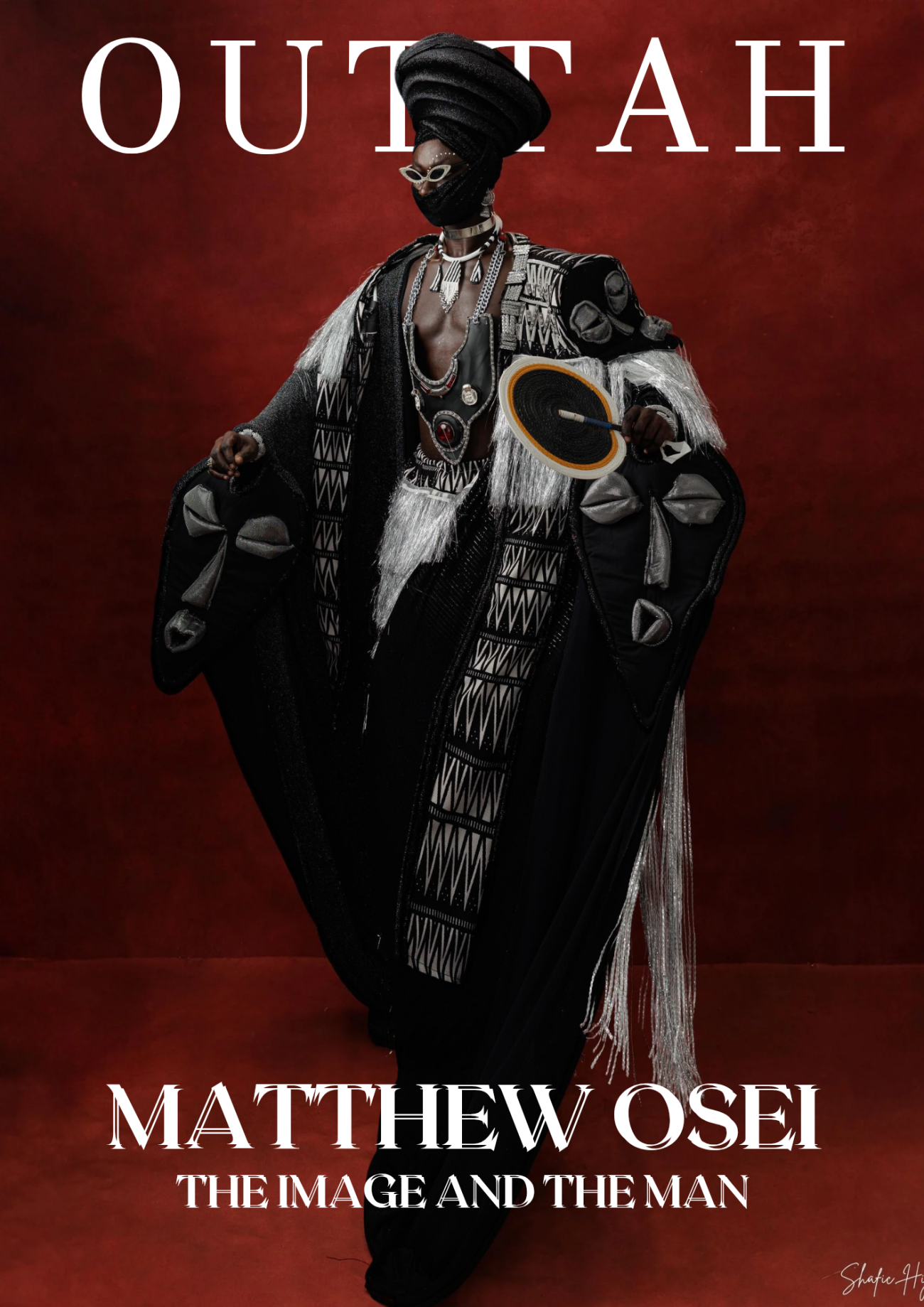
Matthew Osei: the man behind the alter ego KOJ.SEI has built one of fashion’s most striking visual identities from the streets of Accra. But the real story, he’ll tell you, has never been about the clothes.
Somewhere in Accra, Matthew Osei finally goes still. The city outside refuses to; it never does, with its hawkers and heat and the particular density of noise that belongs only to West African urban life. But inside, Matthew is quiet. He has the quality of someone who has learned, perhaps out of necessity, to exist in the eye of things. To be the calm center of a world that keeps spinning loudly around him. The kind of person who takes a beat before answering a question because he actually intends to answer it.
“Matthew is the one who lives the daily reality,” he says, when the conversation turns; as it always eventually does, to the question of identity. “KOJ.SEI is the fearless, larger-than-life creative vehicle.” He pauses. “The difference matters to me.”
It matters to the rest of us too, it turns out. Because in an industry that has a long and well-documented habit of flattening its subjects into a single compelling surface, Matthew Osei has somehow managed to remain genuinely, stubbornly three-dimensional. At once the person and the persona. The heritage and the disruption. The silence and the spectacle.
To encounter @koj.sei for the first time is to feel slightly rearranged. The images don’t announce themselves the way fashion imagery usually does; with aspiration, with want, with the smooth machinery of desire. They do something stranger and more lasting. They ask something of you. They hold eye contact a beat too long. They insist.

The aesthetic is androgynous and architectural, rooted in Ashanti tradition and pointed unmistakably toward something that doesn’t have a name yet. Garments become sculpture. The body becomes archive. Every image carries the emotional weight of a personal document, which is, Matthew will tell you, entirely the point.
“I treat my body as a living canvas,” he says.
“When the camera turns on, I shift into a deeply meditative state. I’m not trying to look good. I’m trying to convey something true.”
What he is conveying, always, is the full complexity of a man that the world spent a long time trying to simplify. Growing up in Ghana, inside the particular silence required of boys whose inner lives don’t match the shapes they’re handed, Matthew learned early what it costs to be different, and what it costs, over time, to pretend that you aren’t.
“Being different felt deeply isolating,” he says, without self-pity. “My fluid expression collided with rigid cultural expectations.”
He lets the sentence sit. Outside, Accra keeps moving.
Before fashion, there was supposed to be something ordinary. A stable career. A life lived within its assigned parameters. Matthew describes this earlier imagined future with a kind of gentle remove, the way you describe a road you considered taking and ultimately didn’t. What redirected him was not a single revelation but an accumulation; the growing impossibility of keeping his real self separate from his visible self. Eventually, the two demanded to merge.
His Ashanti heritage was never background noise in this process. It was, and remains, the frequency everything else is tuned to. The ancestral connection he speaks of is not metaphorical. He means it spiritually, structurally; as a source of creative vocabulary and personal grounding that no amount of industry pressure has managed to interrupt. When he was pushed, early in his career, toward a more commercial version of himself; more marketable, more legible, less strange; it was a return to Accra’s streets, and to his roots, that pulled him back.
“I felt completely detached from the conventional images of myself on billboards,” he says. The memory still carries a trace of something uncomfortable.
“I broke free by stepping away from the lights. Immersing myself back in the raw environment. Reconnecting with my ancestors.”
He says the word “ancestors” the way some people say “home”, with the ease of someone who knows exactly what they mean by it.
The project that changed everything was called “Mushroom Anatomy”. Matthew transformed himself into something organic and entirely unclassifiable; an androgynous living sculpture that existed outside every category fashion typically reaches for. It was not, he is clear, a stunt. It was a discovery. “It proved my body could transcend traditional labels and become a vessel for high art,” he says. “It completely shifted how I saw my own identity. Not as a liability. As a creative asset.”

From there, the work deepened. His evolution from model to conceptual director unfolded with the internal logic of someone who was never really interested in being looked at; only in making people see. His recent work as a stylist on the Hollywood production “Mykito” brought his structural, avant-garde instincts onto a cinematic scale, translating what he had built on Accra’s streets into a global visual language. The world, it seems, was catching up.


But it would be a mistake to read Matthew Osei’s trajectory as a straightforward ascent. There have been real costs. Societal pushback in Ghana. Legal pressures around non-traditional self-expression. The quieter but equally corrosive cost of working in an industry that celebrates Black aesthetics while remaining largely uninterested in Black interiority. “The industry frequently tokenizes Blackness as a trendy, exotic aesthetic while completely ignoring the human being behind it,” he says, with the directness of someone who has stopped softening this particular truth for anyone’s comfort.
“Over time, it causes deep emotional exhaustion. Identity erasure. It can make an artist feel invisible.”
He does not feel invisible. But he has had to fight, consistently and deliberately, to remain visible to himself.
Away from the camera, Matthew Osei is almost aggressively private. He speaks about self-preservation not as a luxury but as a discipline; the careful, daily maintenance of an interior life that makes the exterior work possible. He meditates. He listens to traditional soundscapes. He sits with the quiet. “I’m focused on self-preservation, emotional grounding, and understanding my purpose as a human being beyond the visual world I create,” he says. It sounds simple. It is, he knows, the hardest kind of work there is.

There is a young person, he imagines; same features, same Ghanaian bones, same darkness he once carried alone; who is being told, in ways both loud and quiet, that the world was not built for them. Matthew speaks to this person the way you speak to someone you once were.
“Your differences are not a mistake,” he says. “They are your actual power.” He says it without performance, without the cadence of a rehearsed answer.
“The world might not feel like it was built for you. But that means you are here to build a completely new one.”
Outside, Accra is still going. Matthew Osei sits inside the quiet he has built for himself, deliberately, at considerable cost, on his own terms and seems, for this moment at least, entirely at peace with everything it took to get here.
Follow his work on Instagram @koj.sei
Full interview out on JULY 1
One thought on “Matthew Osei and the Art of Being Seen”