
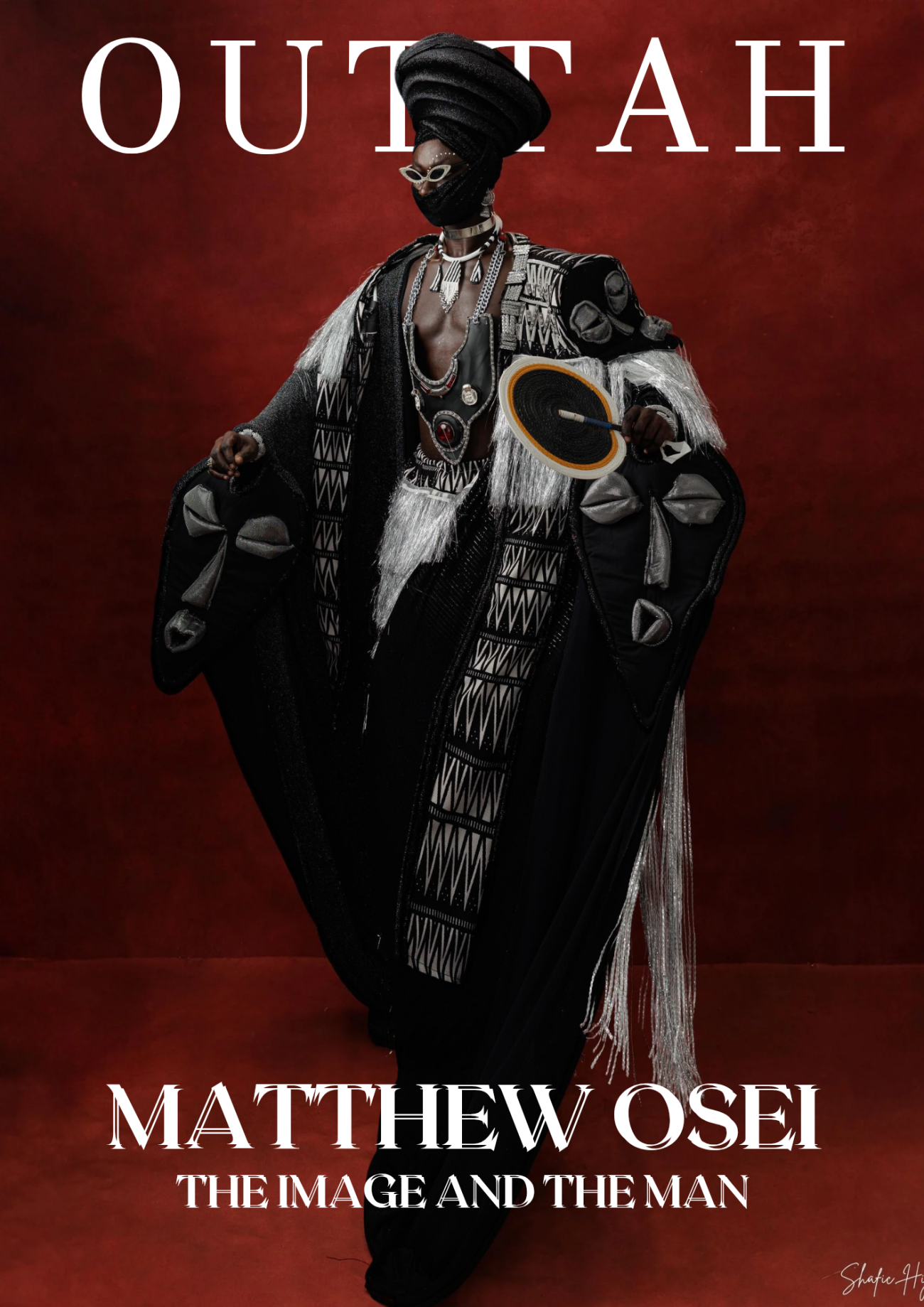
Welcome, Matthew. We’re really glad you’re here. Before we get into everything, we just want to check in.
OTH: How are you doing — honestly? What does life look like for you right now; creatively, emotionally, and personally?
Thank you. Creatively, I am pushing boundaries through high-energy styling and avant-garde art, using Accra’s raw environment to challenge conventional fashion norms. Emotionally and personally, I am in a phase of self-assertion, navigating the complexities of gender fluidity while remaining deeply grounded in my West African heritage.
OTH: Introduce yourself. Who is Matthew Osei, and who is KOJ.SEI, and is there a difference between the two?
Matthew Osei is the private individual rooted in Ashanti heritage, while KOJ.SEI is his avant-garde alter ego; an androgynous model, stylist, and visual disruptor redefining perceptions of West African masculinity. The key difference is that Matthew lives the everyday reality, while KOJ.SEI serves as the fearless, larger-than-life creative force that challenges societal norms on the global stage.

OTH: What kinds of thoughts, emotions, or experiences have been occupying your mind the most lately outside of work and fashion?
Lately, my thoughts have been centered on deepening my spiritual connection with my ancestors, navigating the personal weight of challenging societal expectations in Ghana, and finding peace in the quiet moments away from the camera. I am focused on self-preservation, emotional grounding, and discovering my purpose as a human being beyond the visual worlds I create.
OTH: When people encounter @Koj.sei online, they’re immediately introduced to a very striking visual world. How would you describe the person behind those images right now?
Right now, the person behind the images is a grounded yet fearless visionary—deeply introspective, spiritually connected to his roots, and intentionally choosing authenticity over societal conformity. He is an artist navigating the emotional weight of being a disruptor while prioritizing personal peace, self-preservation, and mental clarity beyond the public eye.
OTH: You’ve developed a very distinct visual identity over time. Talk about the experiences or influences that shaped your relationship with image, style, and self-expression.
My visual identity has been shaped by defying rigid societal norms through an androgynous aesthetic, drawing raw creative inspiration from the vibrant rhythm of Accra’s everyday life, and reclaiming my Ashanti heritage as a living canvas. These experiences have transformed fashion from mere clothing into a powerful medium for personal liberation, spiritual storytelling, and authentic self-expression.


OTH: Before any of this: before the cameras, the agency, the magazine covers; what was the life you thought you were going to live?
Before fashion, I envisioned a conventional life shaped by traditional societal expectations and rigid gender norms in Ghana. My focus was on pursuing a stable, mainstream career while keeping my deepest creative passions and authentic identity hidden from the world.
OTH: Looking back at the past few years of your life, what parts of yourself do you think have changed the most creatively, emotionally, or spiritually?
Creatively, I have evolved from simply modeling clothes to becoming a fearless conceptual director who approaches fashion as a form of structural, ancestral art. Emotionally and spiritually, I have grown far more resilient, moving from a place of concealing my identity to fully embracing my epicene aesthetic and finding profound peace through honoring my Ashanti roots.
OTH: There’s often a quiet intensity in your images that feels very intentional. Walk us through what usually happens internally when you’re in front of the camera.
When the camera turns on, I immediately shift into a deeply meditative state, channeling the struggle and resilience. I treat my body as a living canvas, focusing entirely on conveying power and emotional storytelling rather than just looking good. This internal focus transforms the shoot into a spiritual ritual, creating that signature quiet intensity.

OTH: Has there been a point in this career where you genuinely didn’t recognize yourself anymore; where the distance between who you were and who the industry was shaping you to be felt dangerous? What did that feel like, and what brought you back?
Yes, a commercial push to make me more marketable almost erased my authentic, androgynous self, causing creative suffocation and emotional numbness. I felt completely detached from the conventional images of myself on billboards. I broke free by stepping away from the lights, immersing myself in Accra’s raw streets, and reconnecting with my ancestral roots to reclaim my boundaries.
OTH: What kinds of assumptions do people tend to project onto you because of your appearance, energy, or visual identity, and how do those assumptions compare to who you really are?
People often assume I am unapproachable, hyper-feminine, or simply a superficial fashion figure because of my sharp, androgynous aesthetic. In reality, I am a deeply grounded, spiritually rooted Ashanti man who uses clothing as intentional art rather than vanity. While people expect a loud persona, I am actually a quiet, introspective individual focused on personal peace and community.
OTH: Has this industry ever made you feel like your Blackness was an aesthetic before it was a humanity; like you were being celebrated for the way you look rather than truly seen for who you are? What does that experience do to a person over time?
Yes, the industry frequently tokenizes Blackness as a trendy, exotic aesthetic while completely overlooking the human being behind it. Over time, being celebrated for a superficial image rather than truly being seen leads to deep emotional exhaustion and identity erasure. It can make an artist feel invisible, reduced to a mere prop, and forced to constantly fight to defend their dignity and humanity.

OTH: Describe the tension, if any, between the person people consume visually online and the person you are away from the camera.
My online visual persona is often perceived as loud, fearless, and larger than life; an avant-garde disruptor. Away from the camera, I am a quiet, deeply introspective, and highly private individual who avoids the spotlight. The tension lies in constantly balancing the public’s expectation of a radical fashion icon with my personal need for quiet self-preservation and a grounded daily life.
OTH: Talk about your relationship with masculinity, softness, vulnerability, and emotional expression, especially within environments where those things are not always easily understood.
I redefine masculinity as an expansive, artistic energy by rejecting rigid traditional stoicism in favor of an androgynous “epicene flare.” In environments that demand toughness, I see softness as a revolutionary act of resistance and embrace vulnerability as essential creative fuel rather than a weakness. These qualities keep me spiritually grounded and ensure my art remains uncompromisingly honest.
OTH: Reflect on moments in your life where being different felt isolating, and moments where it eventually became your strength instead.
Growing up, being different felt deeply isolating because my fluid expression clashed with rigid cultural expectations, leading to intense loneliness and self-doubt. Over time, that isolation became my greatest strength as I realized my unique perspective was my most valuable artistic asset. Embracing my distinct identity allowed me to build an authentic global platform, transforming what once made me an outcast into my greatest source of creative liberation.
OTH: Your work often feels emotionally driven rather than simply aesthetic. Describe the emotions, memories, or internal experiences that most strongly influence your creativity.
My creativity is fueled by the emotional weight of defying societal norms, memories of personal isolation, and a deep spiritual connection to my Ashanti ancestors. I transform past pain, vulnerability, and cultural pride into raw visual energy, treating fashion as an emotional archive rather than merely clothing.
OTH: Walk us through your creative process before a shoot or editorial and the kinds of things that help you enter that mental or emotional space.
My pre-shoot process combines structural research with a disciplined ritual of isolation, deep breathing, and traditional soundscapes. This meditative preparation allows me to step onto the set not simply to pose, but to fully embody a specific emotional narrative.
OTH: What has fear looked like in this career; not the manageable kind, but the kind that made you genuinely question whether any of this was worth it?
True fear came from realizing that my safety and sanity were being threatened by intense societal pushback and legal challenges surrounding non-traditional expression in Ghana. That paralyzing fear forced me to choose between my personal peace and my artistic freedom; a challenge I overcame through unwavering creative defiance and the support of a global community.


OTH: Describe a photograph, project, or creative moment that permanently changed the way you saw yourself.
The watershed moment of my career was completing my intricate “Mushroom Anatomy” project, where transforming into an androgynous, organic sculpture proved that my body could transcend traditional labels and become a vessel for high art. This boundary-breaking masterpiece completely shifted my perspective, teaching me to see my identity as a powerful creative asset rather than a liability. That evolution directly paved the way for my breakthrough as a stylist on the Hollywood film production Mykito, where I translated my avant-garde, structural design instincts onto a massive global cinematic stage.
OTH: Reflect on how African beauty, fashion, and identity are currently being represented globally, including the parts that feel authentic and the parts that feel performative.
Globally, African representation feels authentic when raw, homegrown stories, sustainable practices, and traditional textiles are championed by local creatives. However, it becomes performative when Western institutions tokenize African style as a seasonal trend, reducing rich cultural histories to shallow, exotic aesthetics for corporate diversity metrics. True representation requires shifting structural power and ownership back to African soil rather than simply consuming our imagery.


OTH: Talk about the realities of navigating international creative spaces that celebrate African aesthetics while still misunderstanding African people and experiences in many ways.
Global creative spaces often celebrate African aesthetics; our textiles, patterns, and movement, while remaining deeply disconnected from the lived experiences of African people. This creates the painful reality that our art is highly valued, but our humanity, legal vulnerabilities, and structural barriers are often overlooked. True inclusion requires global institutions to look beyond surface-level beauty and actively support the people behind the craft.
OTH: Fashion has taken a great deal from African culture while returning very little. Have you ever felt the tension of that personally; standing in a room where the culture was being celebrated but the people behind it weren’t? How do you carry that?
Yes, I have experienced the pain of seeing African culture celebrated as a trend while the creators behind it are ignored or tokenized. I respond by refusing to be a passive prop, demanding fair compensation, and focusing my energy on building independent creative platforms on African soil.

OTH: If the bookings stopped tomorrow; if the industry decided your moment had passed, who would you be, and would that person be enough for you?
If the industry stopped calling tomorrow, I would simply return to being Matthew Osei, the introspective artist rooted in my Ashanti heritage. Without the cameras, I would still be a creator, using my hands to craft art from my surroundings in Accra. I would no longer have to carry the exhausting weight of a public persona, allowing me to focus entirely on personal peace and spiritual growth. That person would be enough for me because my worth has never been defined by the industry’s validation.
OTH: Years from now, when people revisit your work and your images, what do you hope they understand or feel about the human being behind them?
Years from now, I hope people look beyond the clothing and understand that the person behind the images was a vessel for truth and ancestral storytelling. I want them to feel a sense of absolute fearlessness, recognizing that it is possible to stand fully in your own identity even when the world demands that you hide. More than anything, I hope my journey proves that vulnerability, softness, and pushing boundaries are not liabilities, but the highest forms of strength.

OTH: There is a young person somewhere who looks exactly like you; same features, same darkness, same Ghanaian bones, who has been told in ways both loud and quiet that the world was not built for them. What message do you have for this person?
Your differences are not a mistake or a liability; they are your greatest strength. The world may not feel like it was built for you, but that simply means you are here to build a new one on your own terms. Protect your gentle spirit, never dilute your truth to make others comfortable, and remember that your unique identity is a masterpiece created for liberation.
OTH: Where can people follow your journey and for anyone looking to book you or collaborate, how do they reach you?
You can follow my visual journey on Instagram at @koj.sei. For bookings, creative direction, or collaboration inquiries, use the contact details listed in my Instagram bio or send a direct message to connect with my management team.
Thank You, Matthew!