
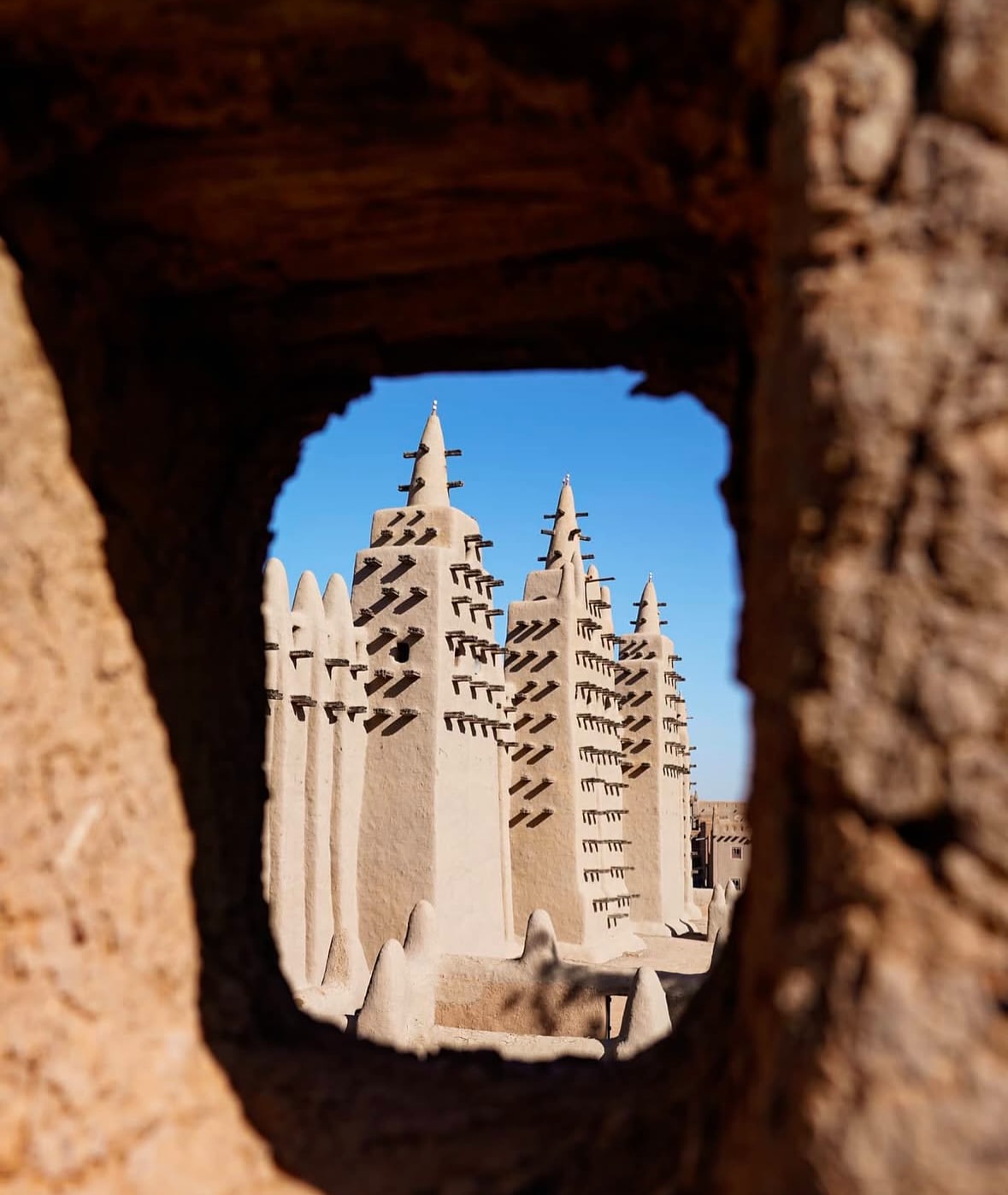
In central Mali, on an island formed where the Bani River swells into the Niger’s inland delta, stands the largest mud building on Earth. Most articles about the Great Mosque of Djenné stop at the postcard facts: it’s 700 years old, it’s made of mud, and once a year the whole town replasters it. All true. But the more interesting story is the one usually left out because the mosque isn’t actually a 700-year-old object. It’s a 700-year-old “idea”, rebuilt in mud so many times that almost nothing physical connects today’s structure to the one that stood in the 1200s. That distinction changes how you should think about the place entirely.
It isn’t old, It’s renewed.
The “700 years standing” line is the version that sells postcards. The building tourists photograph today dates to 1907; the third full reconstruction on the site. The original mosque, commissioned when Djenné’s ruler Koy Konboro converted to Islam and had his own palace torn down to make way for it, crumbled from neglect after a 19th-century ruler abandoned it in favor of a new one nearby. By the time French explorer René Caillié saw it in 1827, it was already a ruin. It was rebuilt in 1836, fell apart again, and was rebuilt a third time in 1907 under mason Ismaila Traoré.

So the “700 years” isn’t the age of the walls; it’s the age of an unbroken commitment to keep replacing them. The only surviving fragment of the original 13th-century mosque is a small side building holding the tombs of past town leaders. Everything else you see is, at most, a little over a century old, and much of its surface is only months old, replastered every spring. The mosque is less a monument than a verb; something the town does, continuously, rather than something that simply endures.
Colonial coercion is baked into the walls
The story usually told is that Djenné’s own mason guild built the 1907 mosque, full stop; a proud, purely African achievement. Recent archival scholarship complicates that. The rebuild happened three years after French colonial forces occupied Djenné, and it was carried out using forced laborers conscripted from surrounding villages, working under Traoré’s direction while musicians played drums and flutes to keep them moving. Some historians argue the tapering, buttressed silhouette itself reflects a “neo-Sudanese” style the French deliberately promoted across West Africa to give their colonial holdings a recognizable, marketable look; a colonial branding exercise layered onto a genuinely local building tradition.
None of this makes the mosque less remarkable. But it means the building that has become Mali’s single most recognizable symbol of pre-colonial African identity was, in its current form, assembled under colonial compulsion. That tension rarely makes it into travel writing.

The mud has a recipe, and it’s basically edible
“Mud” undersells what’s actually in the walls. Masons mix riverbank clay with rice husks, shea butter, and baobab-fruit powder into a paste called banco. The organic additives aren’t decorative; shea butter is water-repellent and helps bind the mixture, while rice husks add tensile strength the same way straw does in adobe elsewhere. Structurally, the mosque works less like a modern building and more like a loaf of bread: something mixed, shaped, and dried, that has to be periodically fed and resurfaced or it will simply dissolve back into the rivers it came from.
The wooden stakes that stick out of every surface; the ones that make the mosque look almost furry in photos, aren’t ornamental either. They’re called “toron”, and they’re permanent scaffolding, left embedded in the walls year-round specifically so masons have something to stand on when they climb up for the annual replastering. The building was designed, from the start, to maintain itself.
Maintenance is a competitive sport


Each spring, before the rains arrive, the town holds the Crépissage; the replastering festival. This part gets covered often, but rarely with the detail that makes it interesting: neighborhoods are organized into rival teams, and they compete to finish their assigned section of wall first. The winning team takes home a cash prize (roughly 50,000 CFA francs, about $90). Griots; West Africa’s traditional oral historians and musicians perform for the workers as they mix and haul mud, turning what is functionally a structural repair job into something closer to a festival with a leaderboard. Women and girls ferry water from the river; men and boys scale the toron to smear on new plaster; elders sit on the terrace walls issuing commentary and advice instead of hauling mud themselves. It’s civic infrastructure maintenance disguised as a party, and it has worked, more or less continuously, for over a century.
One fashion shoot ended a thousand years of open access


For most of its history, the mosque was open to anyone; Muslim or not. That changed in 1996, when Vogue arranged a fashion shoot inside the building, reportedly with local imams’ permission, that involved models in revealing clothing photographed against the mosque’s interior walls. The backlash was severe enough that Djenné’s religious leaders banned non-Muslims from entering the mosque entirely; a restriction that, three decades later, is still in force. Visitors today can only view the interior from photographs or during the Crépissage itself, when access briefly opens for the maintenance work.
It’s a strange footnote: a single afternoon of fashion photography permanently altered how the entire world experiences a building that had welcomed outsiders for nearly a thousand years.
The building is now on a countdown

Since 2016, UNESCO has listed Djenné’s Old Towns; the mosque included as a World Heritage site “in danger,” a designation triggered by the armed conflict and instability that has gripped central Mali. The threat isn’t just security for visitors; it’s continuity of the labor tradition itself. Fewer young residents are staying in Djenné to learn the masonry skills the Crépissage depends on, as rural-to-urban migration pulls people toward larger cities, and traditional banco homes across town are increasingly being replaced with concrete block construction that requires no annual ritual at all. In 2022, insecurity nearly caused the replastering to be canceled outright.
That’s the real stakes of the “700 years” story: it was never really about the mud surviving 700 years. It’s about 700 years of a town deciding, every single spring, that it will show up again. The mosque doesn’t have a structural engineering problem. It has a succession problem and that’s a much harder thing to plaster over.