
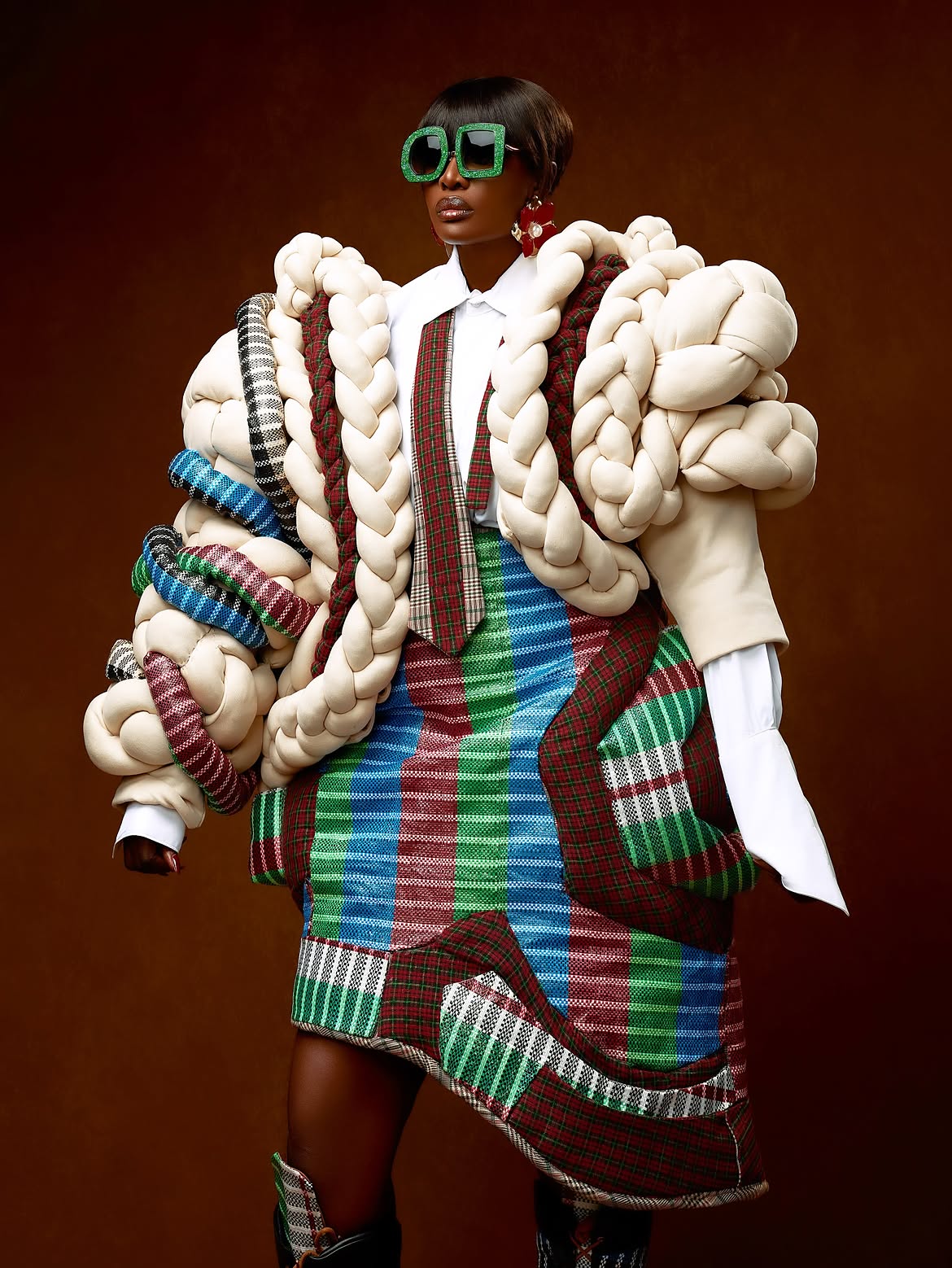
Some fashion moments stop you mid-scroll. Not because they’re shiny or loud, but because they’re saying something. That’s exactly what Nana Akua Addo did at the Dolce & Gabbana show during Milan Fashion Week 2026 and if you know the story behind the print she wore, the whole look hits different.
The Look
A cropped ivory jacket stacked with oversized padded braids, worn over a crisp white shirt and a schoolboy plaid tie. Underneath, a sculpted skirt cut in bold striped green, blue and burgundy. Lace-up boots in matching checks. Green-glitter square sunglasses. It’s architectural, it’s a little chaotic, and it’s completely intentional.

The silhouette takes its cues from Thom Browne; that stiff, uniform-inspired tailoring he’s known for. But the fabric? That’s where the story really begins.
“It’s Like Me Bringing Back Home Our Story”
Caught by a camera on her way into the show, Addo didn’t hesitate when asked about the outfit:
“This outfit is more cultural. It’s like me bringing back home our story. This print is called Ghana Must Go. I’m a Ghanaian, so basically I’m bringing Ghana to Milan Fashion Week and especially, what’s a better way to do it at D&G.”
Simple words, loaded meaning. Because “Ghana Must Go” isn’t just a print name; it’s a phrase with real history behind it.
So What “Is” Ghana Must Go?
If you grew up in West Africa, you already know the bag. That cheap, sturdy, checkered plastic tote that’s carried everything from market goods to school luggage for decades. But its name comes from something far heavier than fashion.


In January 1983, Nigeria’s government ordered undocumented migrants out of the country, giving them just weeks to leave. An estimated two million people were affected, a huge number of them Ghanaians who had settled in Nigeria over the years. Forced to pack up their entire lives in a hurry, many people used the cheapest bags available; those striped plastic totes and the exodus became so associated with them that the bag itself picked up the name “Ghana Must Go.”
It’s worth noting the history runs both ways. Back in 1969, Ghana’s own Aliens Compliance Order had pushed large numbers of foreigners out, many of them Nigerians. Two countries, two expulsions, one shared and complicated history between neighbours.
Turning Pain Into Power
That’s what makes Addo’s choice so striking. A bag born out of forced departure and hardship, reworked into a couture moment on one of fashion’s biggest global stages. It’s not the first time fashion has done this kind of reclamation work, but it hits differently when the person wearing it is Ghanaian herself, walking into a Milan show and naming the print out loud, on camera, without flinching.

She’s a Ghanaian and the story she’s referencing belongs to her directly. That context matters. This wasn’t a borrowed aesthetic; it was personal.
Who’s Behind the Look
The outfit is the work of Nasa Martins, a Nigerian designer Addo was quick to celebrate in the same breath as her outfit reveal: “She’s such a young, talented artist. I love her so much.” A Ghanaian story told through the hands of a Nigerian designer, on an Italian runway; that alone says something about how West African creativity keeps crossing its own borders.

Full credits: Look by Nasa Martins (@nasamartins) · Photography by @edos_artistry · Hair by @laposhair and Hairstylist by @styledbyola__ · Makeup by @luchys.glow
Addo has built a reputation for red carpet looks that do more than just look good; architectural silhouettes, cultural references, tech-infused fabrics. She’s said before that she sees fashion as “a tool, as a voice,” a way to represent West Africa on a global scale without losing what makes it specific.
This Milan moment fits right into that pattern. It’s not just a great outfit. It’s Ghana Must Go, reclaimed, restyled, and walked straight into a Dolce & Gabbana show; history and all.