
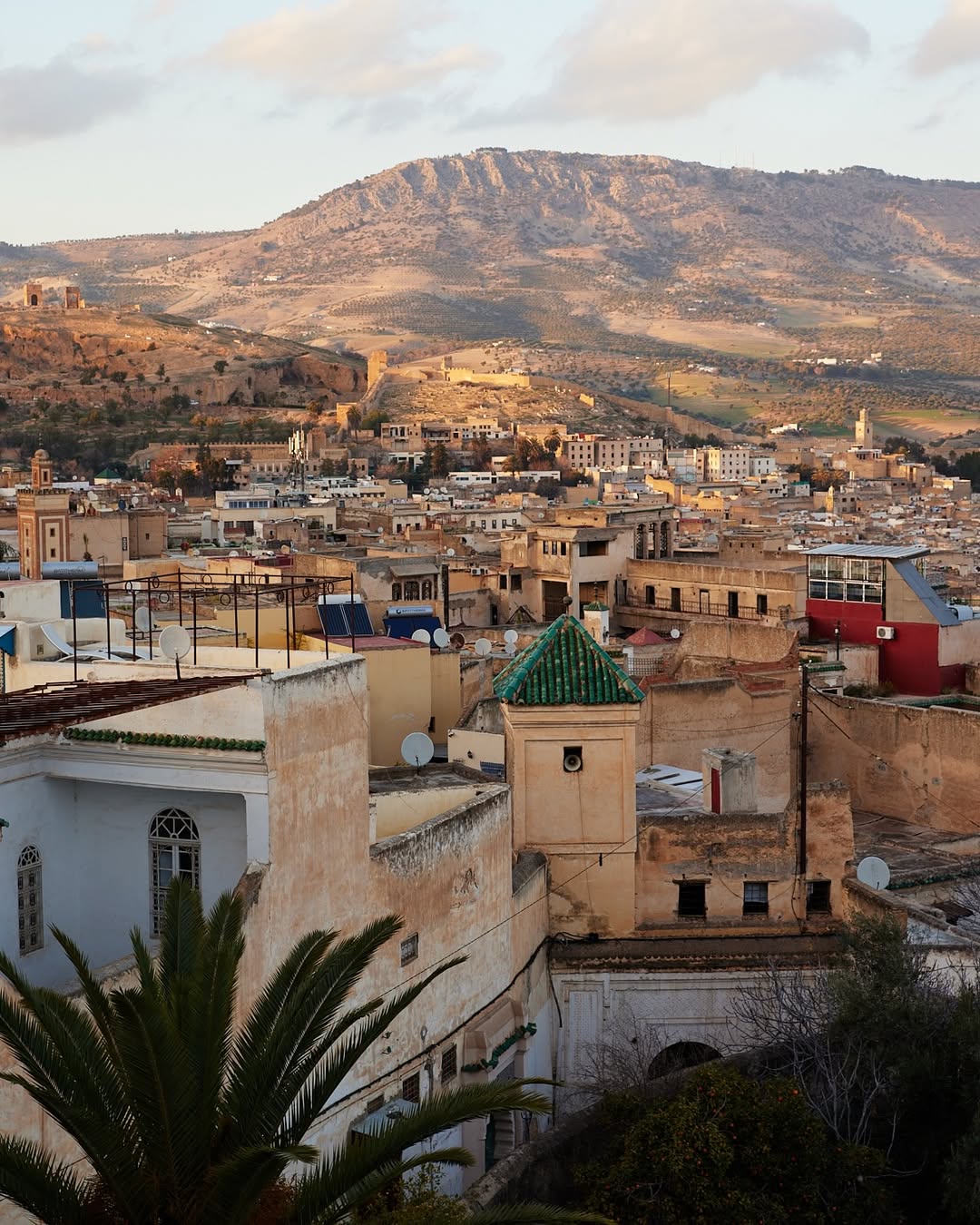
Fez’s ancient medina has been car-free for 1,200 years. But the real story isn’t about traffic. It’s about what a city becomes when it’s built entirely around the human body.
The Accidental Urban Design
When urban planners talk about “walkable cities,” they invoke Copenhagen bike lanes and Melbourne laneways as inspiration. They almost never mention Fez. That’s a strange omission, because the old city of Fez, “Fes el-Bali” is considered the largest contiguous car-free urban zone in the world, with a dense network of more than 9,000 narrow alleyways that have evolved over more than a millennium.

The medina wasn’t designed to be car-free. It was designed before the concept of a “car” existed in any human imagination. And yet, what the city’s founders built in the 9th century anticipates nearly everything that 21st-century sustainable urban design is desperately trying to recreate; passive cooling, acoustic comfort, pedestrian-scale streets, mixed-use neighborhoods, distributed water infrastructure. They didn’t call it any of those things. They just called it a city.
Dating back to the Idrisid Dynasty, where it was the regional capital between 789 and 808 AD, more than 90,000 people live within its fortified walls today. That is not a museum. That is a functioning, populated, breathing city; operating on a blueprint that has never needed a fundamental revision.
Those Narrow Alleys Were Never a Mistake


The first thing visitors notice in Fez is how “tight”everything feels. Many alleyways are so narrow that two people must turn sideways to pass each other. A modern observer tends to read this as a deficiency; a city that simply ran out of space, that hadn’t yet “developed.” But this interpretation has it exactly backwards.
Compact, narrow alleyways provide extensive self-shading and harness prevailing winds for ventilation; a microclimatic strategy seen across North African medinas, where street geometry was critical in enhancing pedestrian comfort and passive airflow.


In a city that regularly sees summer temperatures above 35°C, these corridors function as natural air conditioning. The tall flanking walls block direct solar radiation for most of the day. The narrow geometry creates a chimney effect, drawing cooler air upward and letting heat escape. Residents weren’t tolerating cramped streets; they were inhabiting a thermodynamic system their builders understood intuitively.
Modern architects spend enormous budgets and energy mechanically achieving what the medina’s geometry achieves for free, every single day, using nothing but stone and spatial logic.
What Does a City Sound Like Without Engines?
In every other major city on earth, the baseline acoustic environment is defined by the internal combustion engine. Traffic noise is so ubiquitous in modern urban life that most people have stopped consciously hearing it. Chronic exposure elevates cortisol levels, disrupts sleep, impairs cognitive function in children, and accelerates cardiovascular disease. The World Health Organization considers it the second-largest environmental health threat in Europe, behind only air pollution; much of which is also produced by cars.

Inside the medina of Fez, the soundscape is almost entirely human. You hear voices, hammers on copper, the call to prayer, the clip of donkeys’ hooves on stone, the scent of spices and tanned leather; a sensory experience that is both overwhelming and exhilarating.
What that represents neurologically is profound. The brain’s threat-detection systems respond very differently to a donkey passing at 4 km/h than to a motorbike at 60. The medina’s acoustic environment isn’t just pleasant; by the standards of modern urban health research, it is genuinely therapeutic. A city that has been acoustically safe for 1,200 years isn’t a relic. It’s an experiment with a very long dataset, and the results are extraordinary.
The University That Predicted Oxford
Here’s a fact that gets repeated often but almost never fully grasped.
Founded in 859 AD by Tunisian-born Fatima al-Fihri, the University of Al-Qarawiyyin is recognized by UNESCO and Guinness World Records as the oldest existing, continually operating educational institution in the world and the first to be founded by a woman.

The typical framing treats this as a remarkable historical footnote. But it underestimates what actually happened here. Al-Fihri’s idea was to create a social space enabling intellectual exchanges for progressive learning and teaching; a professional and institutional learning structure previously unseen and unheard of, which echoed across the European continent in the following centuries.
The university model; the idea that a dedicated institution could systematically produce, preserve, and transmit knowledge across generations, was developed and “proven” in Fez before it existed anywhere in the Western world. Oxford wasn’t founded until around 1096. Bologna, often cited as Europe’s oldest university, dates to 1088. Al-Qarawiyyin had been operating for over 200 years before either of them opened their doors.

It was in those ornate, mosaic-tiled halls that early algebra was being studied, and where Pope Sylvester II first encountered Arabic numerals and brought them back to Europe. The numerical system that undergirds all of modern mathematics, computing, and engineering passed through a pedestrian city in Morocco on its way to changing the world.
Other notable scholars associated with Al-Qarawiyyin include Ibn Khaldun, the pioneering sociologist and historian; Ibn al-Arabi, the influential Sufi mystic; and Maimonides, the renowned Jewish philosopher and physician. Christian, Muslim, and Jewish scholars sharing corridors, debating cosmology and medicine in a car-free city. That kind of cross-pollination is what most modern cities spend decades and billions of dollars trying to cultivate.
The Tanneries: An Industry That Never Had to Modernize

The Chouara tannery, the largest of three medieval tanneries in Fez, still uses traditional methods dating back centuries; workers soaking hides in stone vats of natural dyes including saffron, mint, poppy, and indigo.
They’re usually presented as a colorful photo opportunity. But they represent something far more striking: an industry operating continuously for nearly a thousand years, in the same location, using the same methods, without degrading the surrounding urban fabric.

Modern industrial production is typically incompatible with dense residential living. Factories require truck access, heavy logistics, noise buffers, pollution controls. The Fez tanneries have none of this; and they have existed within feet of homes, schools, and mosques for centuries. The reason, in part, is that the absence of vehicles forced every industry in the medina to remain human-scaled. You cannot build a mega-factory in a city where your only freight option is a donkey. The constraint produced a form of industrial self-regulation that no zoning law could have achieved.
The Uncomfortable Question It Poses to Modern Cities
The deepest challenge that Fez poses isn’t about traffic or architecture. It’s about the assumption that human progress is linear; that each era improves on the last, that modern cities represent an advancement on what came before.
Cities around the world are currently spending billions trying to undo damage done by the 20th century’s love affair with the automobile. They’re building bike lanes, removing highways, capping parking, narrowing roads, creating pedestrian zones. They are, in other words, trying to become a little more like a city that a woman from Tunisia decided to build in Morocco in 859 AD.

The government recently allocated MAD 670 million ($70.3 million) for the Fez Medina development program, aiming to enhance residents’ quality of life by restoring 1,197 historic buildings. The investment is welcome. But it’s worth sitting with the irony: a city that has been continuously inhabited for 1,200 years; car-free, pedestrian-first, community-scaled; now needs restoration assistance from a world that spent a century doing it the other way.
The medina’s problems don’t come from its urban logic, which remains sound. They come from pressure applied “from outside”; tourism economics, surrounding infrastructure designed for cars, global supply chains that make traditional crafts economically marginal.
Strip all of that away, and what you’re left with is a city that got most of the big things right on the first try.
She didn’t call it sustainable urbanism. Fatima al-Fihri just called it home.
The medina of Fes el-Bali is a UNESCO World Heritage Site and the world’s largest car-free urban zone, home to over 90,000 residents and millions of visitors annually.