
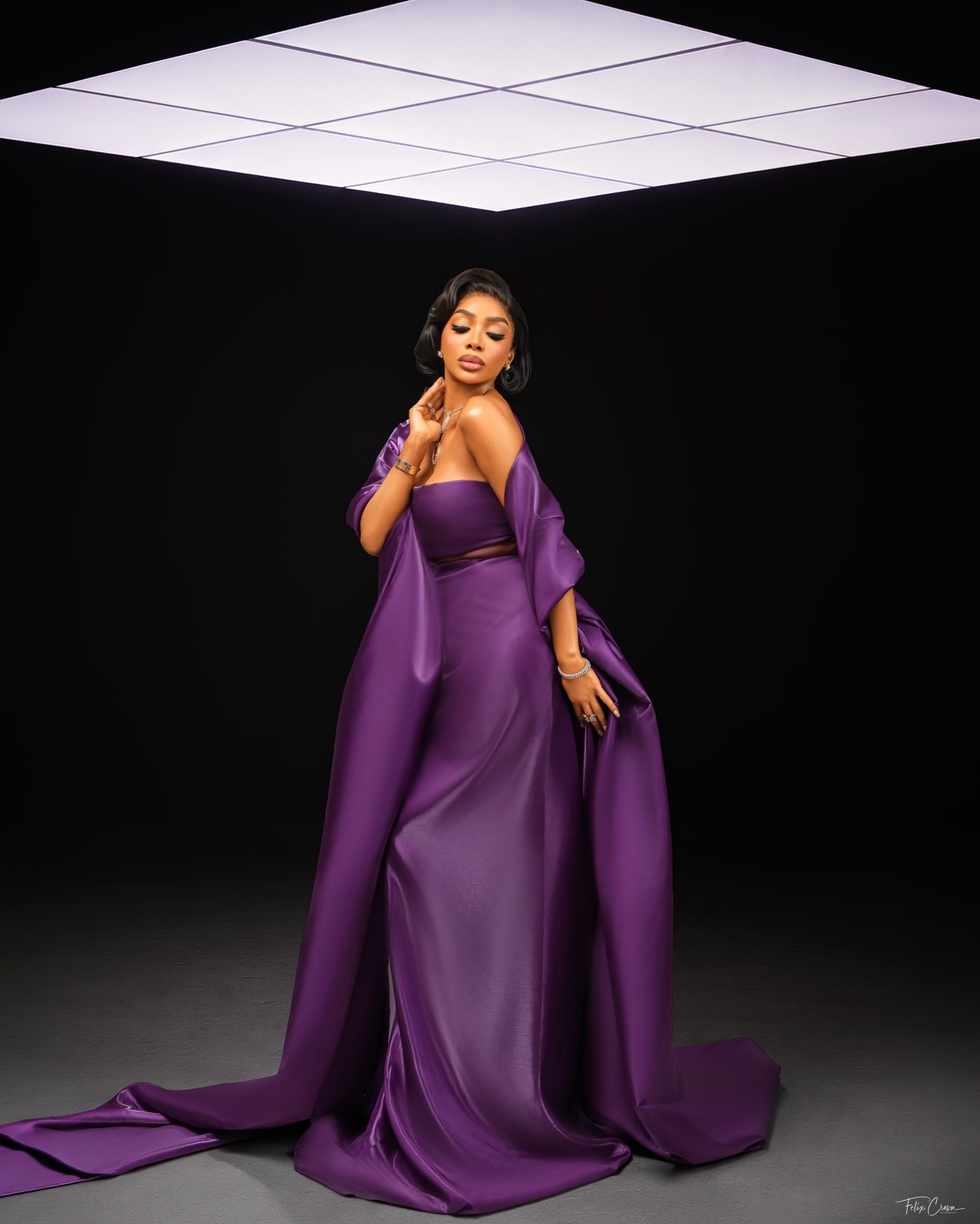
Every year, Chioma Ikokwu (aka Chioma Good Hair) turns her birthday into a fashion event, and this year’s centerpiece look; shot by longtime collaborator Felix Crown; is less “dress” and more “engineered fabric.” One continuous length of deep-purple satin has been wrapped, pinned, and sculpted directly onto her body to create the illusion of a strapless gown with sweeping, floor-grazing sleeves. There’s no visible seam telling you where the “top” ends and the “cape” begins because there isn’t one. It’s drapery, not tailoring, and that distinction is the whole story here.

Draping is an old couture skill; pattern-cutters build a silhouette directly on a live body or a mannequin rather than cutting from a flat paper pattern. It’s how a lot of red-carpet “moment” dressing actually gets made, because it lets a stylist manipulate volume in real time until the fabric falls exactly right for that body, in that pose, under that light. You can see the fingerprints of that process all over this shoot:
• The bodice is the only truly built element. Across every frame it holds a clean, straight strapless line across the chest with no visible boning lines or seams showing through, which suggests it’s either a fitted foundation piece the drape is anchored to, or the satin itself has been pinned taut enough at the top edge to hold that architecture on its own.
• Everything below the shoulder is unstructured. The “sleeves” aren’t sleeves at all; they’re excess yardage gathered at the shoulder point and left to fall, which is why they behave differently in every photo: sometimes hanging straight down like columns (the full-length black-background shots), sometimes lifted and thrown back over the forearm (the raised-arm shot), sometimes wound once around the elbow and left loose again (the close-up portraits). That’s the signature of draped fabric rather than a sewn sleeve; a sewn sleeve would hold one shape; this moves.
• The train is where the “wow” budget went. The excess fabric doesn’t stop at the ankle; it keeps going, fanning out across the floor in soft, overlapping folds rather than a single tapered point. In the wide shots you can see it’s been arranged by hand after she posed, not simply let fall, because the folds break in deliberate diagonal lines that lead the eye back up to her face.
• The sheer waist cutout is the quiet technical flex. A narrow band of illusion mesh interrupts the solid satin right at the natural waist, visible in the front-facing shots. It does two jobs at once: it hints at a cinched waistline without an actual seam breaking up the fabric’s continuous fall, and it gives the torso a “peek” of skin that keeps the silhouette from reading as a solid column of purple. That’s a considered design decision, not an accident of draping; someone built a gap into the plan.
Color as lighting strategy, not just a mood board choice

Deep aubergine-purple is a shrewd pick for a fabric this reflective, and it’s doing something specific in each setup:
• Against pure black, the satin nearly disappears into the shadows at the edges and only catches as saturated violet where the studio light hits a fold directly; which is why the full-length black-backdrop shots feel dramatic and almost sculptural, like the dress is emerging from the dark rather than standing in front of it.
• Against warm brown, the same purple reads several shades richer and almost bruised-plum, and it pulls warmth up into her skin tone rather than fighting it; that’s the softest, most “intimate portrait” version of the look.
• Against grey marble, the purple goes cooler and more jewel-toned, closer to true violet, and the veining in the marble gives the frame texture so the eye doesn’t just land on flat color.
That’s three different emotional registers out of one dress, purely by changing the backdrop proof that satin in a saturated jewel tone was chosen specifically because it’s reactive to light, not just because purple is a flattering color on her.
The overhead light panel as a recurring motif

Several of the full-length shots are built around the same square panel light suspended overhead, shot from an angle so it reads almost like a floating monolith or a skylight. It’s an unusual choice; most gown photography lights from the front or side to flatter the face and fabric evenly, but here the panel does double duty: it throws a soft, diffused wash down onto her face and shoulders (avoiding harsh shadows under the brow and jaw), while the rest of the frame stays in near-total black, which is what makes the train and sleeves look like they’re glowing faintly at the edges rather than just sitting in shadow. It’s a small production detail, but it’s the difference between “gown on a plain backdrop” and “gown as the single object under a spotlight.”
Hair, makeup, jewelry: restraint as a styling choice
The finger-waved, vintage-glam bob is doing a lot of tonal work. It pulls the whole look toward old-Hollywood siren rather than contemporary red-carpet dressing, which suits the draped-toga construction of the gown far better than a sleek modern updo would; this is a look referencing 1940s-50s studio glamour photography, not 2020s minimalism.

Makeup stays in a warm, sculpted register throughout: heavy definition on the brow and a graphic winged liner, a soft glossy nude-mauve lip that catches light without competing with the jewelry, and enough highlight strategically placed on the collarbones and shoulders that the bare skin does its own reflecting alongside the satin rather than looking flat next to it.
Jewelry is layered but restrained; a double-strand necklace with oval pendant drops, a stacked diamond bangle, a solid metal cuff, and a cocktail ring. None of it is loud enough to compete with the dress; instead it’s placed precisely in the negative space the draping leaves open; the bare shoulders, the exposed collarbone, the sheer waist strip; so it reads as accenting the architecture of the garment rather than decorating on top of it. That’s a deliberate hierarchy: dress first, skin second, jewelry third.

Birthday shoots are one of the few times a public figure gets to dress purely for spectacle; no red-carpet dress code, no brand activation to serve, no obligation to make a garment “wearable” beyond the four walls of a studio. Choosing a draped, sculptural satin piece over a conventional constructed gown signals that this is fashion as art direction, not just “an outfit for the day.” It photographs differently in every single frame; the same length of fabric reads as a toga in one shot, a caped gown in another, a wrapped stole in a third, a pooling train in a fourth; which is exactly the point of building a look around drapery instead of a fixed pattern: one piece of cloth, engineered light, and a body used as the armature, producing what amounts to an entire lookbook out of a single garment.