
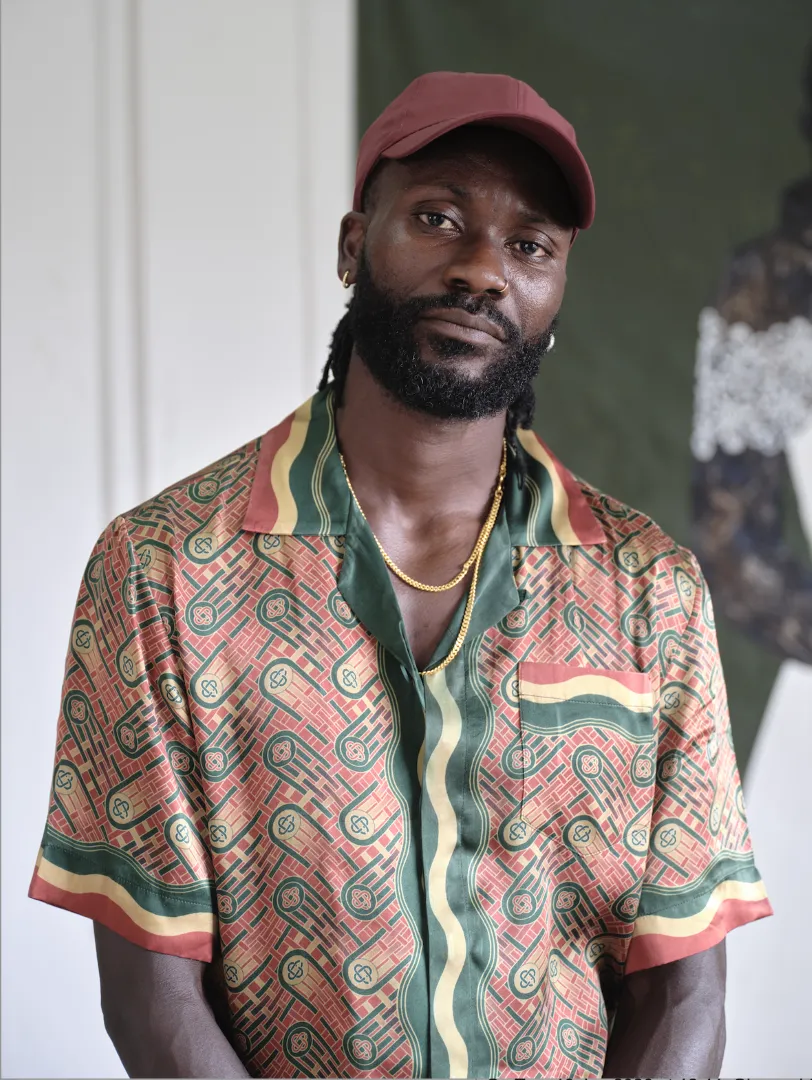
“It Doesn’t Have to Always Make Sense” arrives just ahead of the 61st Venice Biennale and right on time for the conversation the art world needs to be having.
Ghanaian painter Amoako Boafo’s first solo show in Italy, “It Doesn’t Have to Always Make Sense”, is unmistakably the latter; opening May 6, 2026 at Museo di Palazzo Grimani and running through November 22. Produced in collaboration with Gagosian, the show is strategically timed to land just before the curtain rises on the 61st Venice Biennale, placing Boafo at the very epicentre of global artistic attention as the world descends on Venice. It is a debut that carries weight far beyond the gallery walls.
The 16th-century palazzo; an architectural anomaly within Venice for its Tuscan-Roman Renaissance influences, has in recent years developed a distinctive curatorial approach, inviting contemporary artists to engage directly with its historic interiors. It is a space that does not simply host art; it enters into conversation with it.
The new and recent works, many of which directly reference the unique architecture and historical context of the site, are installed on the second floor of the palazzo, establishing a dialogue between contemporary Black representation and the enduring legacy of Venetian artistic masterworks. Boafo has not arrived as a guest in someone else’s story; he has walked in as a protagonist, his figures occupying Renaissance rooms with the same confidence and self-possession that defines his entire body of work.
His painterly practice reconsiders the genre of portraiture as a device for affirming identity and presence, with a direct gesture achieved by manipulating pigment with his fingers, making the creative process visible and endowing his figures with strong physical and psychological intensity. That touch; intimate, deliberate, undeniably human, is the thread that runs through everything Boafo makes. In the context of Palazzo Grimani, it becomes something even more charged: a hand reaching across centuries of art history and rewriting who gets to be seen.
Born in Accra in 1984, Boafo initially trained as a self-taught artist, approaching drawing and painting from childhood, and graduated in 2008 from the Ghanatta College of Art and Design in Accra, receiving the institution’s award for best portrait painter that same year. His trajectory from Accra to Vienna; where he studied at the Academy of Fine Arts and co-founded WE DEY, a centre for exhibitions, workshops, and community programs, shaped a practice deeply rooted in both the African experience and the European art historical tradition he now inhabits on his own terms.
Gagosian notes that Boafo is inspired by the expressionistic portraiture of Vienna Secession artists Gustav Klimt and Egon Schiele; a lineage he draws from without being consumed by. Where those artists turned inward, Boafo turns outward, centering Black subjects in a genre that has long excluded them, rendered with a specificity of style, gesture, and fashion that refuses to flatten identity into symbol.

His elegant paintings elevate his subjects, capturing their confidence, style, and character; an act that is simultaneously aesthetic and political in a European museum context. His figures are not explained or justified for a white gaze. They simply “are”, radiant and whole.
Boafo’s ascent on the global stage has never been disconnected from home. In 2022, he opened dot.ateliers; an arts hub with artist residencies in Accra, where he is based. The initiative reflects a broader commitment that runs through his work: the belief that the next generation of African artists should have the infrastructure, the community, and the space to build without having to leave in order to be taken seriously.
The Venice exhibition is, in many ways, a product of that same philosophy; not an assimilation into a Western canon, but an expansion of it. Boafo does not arrive at Palazzo Grimani in search of legitimacy. He arrives to reframe what legitimacy has always looked like.
As Venice prepares to welcome the global art world for the 61st Biennale, Boafo’s exhibition stands as one of its most anticipated parallel presentations; a show that not only underscores the continued ascent of one of Africa’s most compelling artistic voices but also reaffirms the importance of placing contemporary African art within the architectural and historical centres of global culture.
The title itself, “It Doesn’t Have to Always Make Sense”, feels like both a creative permission slip and a quiet provocation. It resists the demand for neat narratives. It refuses the expectation that Black art must constantly explain itself, justify its presence, or translate its meaning for an imagined audience that doesn’t include us. In a palazzo built in the 16th century, in a city that has shaped the Western art canon for half a millennium, Boafo plants a flag and simply lets his work breathe.
That, perhaps, is the most radical gesture of all.
Amoako Boafo: It Doesn’t Have to Always Make Sense runs May 6 – November 22, 2026 at Museo di Palazzo Grimani, Venice. Presented in collaboration with Gagosian.