
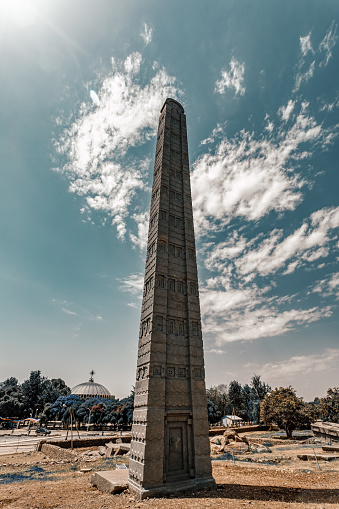
There is a city in the highlands of northern Ethiopia where the earth sprouts stone towers taller than ten-story buildings, carved from single blocks of rock, erected by a civilization that Rome acknowledged as a peer, and that history then forgot for over a thousand years.
The obelisks of Aksum are not merely monuments. They are a riddle written in granite. And the deeper you look, the stranger the questions become.
The Scale of the Impossible

Before confronting the mysteries, the raw engineering demands your attention.
The largest of the Aksum stelae known as the Great Stela was carved with doors and windows to mimic a 13-story building and once stood around 100 feet high. Weighing more than 570 tons, it was hewn from a single block of granite-like rock cut from a quarry two and a half miles away.
To appreciate what that means: at more than three times the height of the biggest of Easter Island’s moai statues and nearly 20 times heavier than the mightiest of Stonehenge’s sarsens, it is among the largest monolithic sculptures ever created and transported.
And the Aksumites almost certainly had no wheels adequate to the task. No crane technology. No recorded instruction manual.
The Great Stela fell during its attempted erection. Despite having successfully quarried this monolith and transported it about 2.5 miles to the site, erecting it proved too great a challenge for the Aksumite architects and engineers. This single detail is extraordinary: they moved a 570-ton single stone across miles of highland terrain; and failed only at the very last stage. The knowledge of “how” to move it died with the civilization that tried.
A City Built Downward as Much as Upward
Here’s what most people miss entirely: the monuments you see above ground are only half the story.
The obelisks were the visible tips of an elaborate underground world. Unique in the complex are the fourth-century Tomb of the Brick Arches, where a staircase descends into multiple stone-walled rooms adorned with horseshoe-shaped brick arches, and the fourth- or fifth-century Tomb of the False Door, where a life-sized carved door stood above stone slabs concealing the tomb entry.
The “false door” is a motif that recurs obsessively across Aksumite architecture; both above and below ground. It appears on the stelae themselves, on tomb facades, and in underground chambers. Why does a civilization carve doorways that go nowhere?
In Egyptian tradition, the false door was a threshold between the living and the dead; a portal through which offerings could be spiritually received. In Aksum, the obsessive repetition of this motif across every level of their architecture suggests a cosmological system far more sophisticated than we’ve decoded.
The obelisk, in this reading, is not just a tombstone. It is a “vertical axis” connecting the buried dead below to the visible sky above; with the false door as the membrane between worlds.
The Forgotten 600
Almost every article about Aksum focuses on the three royal giants of the Northern Stelae Park. This fixation obscures an equally important site nearby.

An additional 600 rough-hewn stelae lie to the west at the Gudit Field, a non-elite necropolis of the second to fourth century.
Six hundred stelae for “ordinary people”, in a city of perhaps 20,000 inhabitants. That is a per-capita investment in funerary architecture almost without parallel in the ancient world.
What does it mean for a society to dedicate this level of stone to ordinary graves? The implication is that the belief system behind the stelae was not merely a royal ideology imposed from the top. It was “deeply, widely held.” Ordinary Aksumites apparently believed that their dead also required a stone marker reaching toward the sky.
The Gudit Field reframes everything. The stelae were not monuments to kings. They were the expression of an entire civilization’s theology about the relationship between earth, sky, and the afterlife.
The Architecture of a Lost Religion
About fifty stone pedestals on the stelae are believed to have held metal statues of Aksum’s pre-Christian kings. Metal plates bearing the faces of kings were riveted to the stelae. Altars for animal sacrifices were fitted to their bases.
This detail is almost never emphasized: the stelae were not static stone pillars. They were dressed with metal faces, topped with metal figures, and actively used for sacrifice. They were, in the truest sense, “temples in pillar form”.
Comparatively little is known of the religion of pre-Christian Ethiopia. Only fragmentary information is afforded by classical authors, by the victory stelae erected by a few Aksumite rulers, and by the evidence of archaeology.
Yet here is a question that sits at the edge of every scholarly treatment and is never directly confronted: the Aksumites adopted Christianity in the fourth century and, in doing so, abandoned this entire cosmological framework. The stelae were likely built by both pre-Christian and Christian kings.
A civilization that converted to Christianity with enough conviction to become the first sub-Saharan African nation to adopt it as a state religion; still continued erecting monuments rooted in a pre-Christian theology of sky, earth, and sacrificial kingship.
The conversion of Aksum was far more syncretic, negotiated, and complicated than the official narrative allows.
The South Arabian Shadow
The Aksumite stelae are African monuments, but they carry the genetic fingerprint of a civilization across the Red Sea.
Numerous Himyaritic (Arabic) inscriptions on the stelae and throughout the city reveal a mingling of Arabian and African influences. The Aksumite people were a mixture of Cushitic-speaking peoples from the Ethiopian highlands and Semitic-speaking southern Arabians who settled the territories around the Red Sea about 500 BCE.
The decorative vocabulary of the stelae; the recessed panel windows, the projecting ledges mimicking floor-lines, the false doors; descends from South Arabian building traditions, not from the Nile Valley. Egypt is usually invoked as the cultural ancestor of African monumental architecture. But the Aksumite obelisks are genealogically closer to the temples of Marib in Yemen than to the pylons of Karnak.
Africa’s greatest obelisks are, in their deepest cultural DNA, part Red Sea Arabian. This cross-continental hybridity; African stone workers executing South Arabian architectural grammar, produced something wholly original. It was the world’s first “Afro-Arabian art form”, and it has received almost none of the comparative scholarly attention it deserves.
The Sunlight Engineered Into Stone
One physical design detail of the stelae has attracted almost no public attention, yet it reveals something profound about Aksumite intentions.
The indentations on each side of the Great Stela are elaborately undercut. This concept causes the strong Aksum sunlight to enhance the apparent relief of the carved surfaces.
The Aksumite stone-carvers did not simply carve their monuments, they calibrated them to the specific quality of light at their latitude. The deep undercutting was not decorative excess. It was optical engineering. The carvings were designed to read at the angle and intensity of Ethiopian highland sun, throwing dramatic shadows across false windows and doors that would appear to glow or recede at different hours of the day.

Special features include the site’s alignment with cardinal directions and solstices, hinting at astronomical knowledge. The three colossal obelisks of the Main Stelae Park were intended to form a single alignment.
A deliberate alignment of three massive monoliths along a single axis is not the behavior of a civilization simply burying its kings. It is the behavior of a civilization “mapping something”; be it solar movement, celestial north, or some cosmological axis connecting the royal dead to the heavens above.
The fact that this alignment has never been subjected to rigorous archaeoastronomical study comparable to what has been lavished on Stonehenge or the pyramids at Giza is one of the great oversights of contemporary scholarship.
The Collapse That Changed a Religion
Here is perhaps the most explosive argument in Aksumite scholarship, and one that almost nobody has heard.
One scholar has suggested that the apparent failure to erect the largest stela, which evidently cracked and fell as it was being installed, may have accelerated adoption of the new religion.
Think about what this means. The Great Stela was the supreme expression of the old cosmological order; a palace for the dead king, a pillar connecting earth and sky, the most ambitious single stone ever moved by human hands. It fell. It shattered the roof of the funerary chamber beneath it. And within decades, the Aksumite court embraced Christianity and abandoned the stelae tradition entirely.
The coincidence is too compressed to ignore. A civilization’s greatest monument fails catastrophically at the precise historical moment a competing religion is gaining influence at court.
In this light, the fall of the Great Stela is not just an engineering story. It may have been the single most “theologically consequential structural failure in African history”; the moment when the old gods visibly and concretely failed, and a new faith stepped into the vacuum.
The Deliberate Destruction Nobody Talks About
History long assumed the Great Stela fell during construction; a victim of overreach. Recent scholarship has quietly overturned this.
Recent analysis shows that Stela 1 did not fail during construction but was intentionally toppled as the empire declined in the late sixth century.
Somebody “pushed it over.”
A monument to a pre-Christian king, carved with the imagery of a palace for the dead, was deliberately destroyed by people who understood exactly what it represented. This is a radical reframing. The Great Stela is not a monument to ambition outstripping capability. It is a monument to a civilization “turning against its own past.”
Whoever ordered its demolition was making a theological and political statement of enormous force: “The old world is over. The dead kings who lived in these stone towers are not gods. They fall.”
Stela 2, by contrast, was accidentally destroyed: treasure seekers looting the subterranean tomb under the monument disrupted its foundational structure, sending the stela smashing to the ground.
Two different fates. One stela pulled down by religious politics. Another brought down by greed. Together, they tell the full story of what happens when a civilization loses faith in its own monuments.
The Deforestation Nobody Mentions
The obelisks are stone, and stone endures. But the environment that produced them has not.
To quarry, transport, and raise hundreds of massive monoliths over several centuries required not just human labor but enormous quantities of timber; for sledges, rollers, levers, ramps, and scaffolding. For centuries, trees had been chopped down and agricultural fields planted, and the land was becoming increasingly barren due to soil erosion.

Here is a connection almost never drawn: the stelae may have contributed to their own civilization’s undoing.
Every giant monolith transported from Gobedra Hill required vast quantities of felled timber. Every generation of royal building cleared more highland forest. By the time Islamic trade networks cut off Aksumite commerce in the seventh century, the agricultural land that might have sustained a resilient interior economy was already depleted. Commercial activities in Aksum started to decline around the late sixth century due to a combination of factors, including a series of invasions by neighboring nomadic tribes like the Bedjas from eastern Sudan and the gradual degradation of farmlands which gravely affected yields.
The monuments that proclaimed Aksumite power may, in their very making, have quietly hollowed out the ecological foundations on which that power rested.
The Shield at the Summit
One of the most recently proposed, and least publicized; interpretations concerns the very tops of the stelae. That distinctive curved, rounded summit capping each decorated obelisk has been explained variously as aesthetic convention or as a representation of the moon.
But a new interpretation has been proposed for the very distinctive outline of the top of the monuments: it may have been shaped after a specific type of shield also occurring in Meroitic and Post-Meroitic contexts, in what is now Sudan.
If the summit of each stela is a “shield”; the most charged symbol of royal military power, then the obelisks are not just palace-tombs. They are armed.
Each one becomes a king standing at attention: his palace-body rising from the underground burial, his carved stone home stretching skyward, his warrior’s shield held aloft in permanent defiance at the summit. The false doors become palace gates. The sacrificial altars at the base become throne-room floors. The entire monument coheres as a full-body portrait of royal power; from the underground tomb where the physical king lay, through the carved stone palace of his eternal residence, to the shield raised toward the sky.
The Kingdom That Survived by Forgetting Itself
After a second golden age in the early sixth century, the empire began to decline, eventually ceasing its production of coins in the early seventh century. Around the same time, the Aksumite population was forced to go farther inland to the highlands for protection, abandoning Aksum as the capital. The capital was moved to a new location, currently unknown, though it may have been called Ku’bar or Jarmi.
Read that again: the successor capital of one of antiquity’s great empires is simply “unknown”. We cannot find it. One of the most powerful civilizations in the ancient world dissolved into a kingdom whose very center we cannot locate. It retreated into the highlands, shed its name, and became Ethiopia.
It survived. But it survived by forgetting.
The Ge’ez language survived. The Orthodox Christian church survived. The Kebra Nagast survived. But the engineering knowledge that built the stelae did not survive. The religious cosmology that demanded them did not survive. The political identity that called itself Aksum did not survive.
What remained were the stones themselves; standing in a field, carved with the faces of buildings for kings whose names no one remembered, above tombs that looters had emptied, in a city that had become a market town.
What the Silence Means
The obelisks of Aksum have spent seventeen centuries in a dusty Ethiopian highland city; studied sporadically, looted occasionally, reclaimed belatedly. In the broad sweep of world history, they’ve been treated as footnotes to more famous civilizations. Less photogenic than the pyramids. Less mythologized than Stonehenge. Less legible than Rome.
This dismissal is the product not of any deficiency in the monuments themselves, but of “where they stand”.

Africa’s greatest pre-colonial empire built the heaviest monoliths any civilization ever attempted. It built them with optical precision calibrated to the sun of its specific latitude. It aligned them to celestial axes that have never been properly measured. It carved onto each one a complete cosmological worldview; palace, sky, underground tomb, false door, warrior’s shield, expressing a theology of royal death and divine continuity that was both wholly original and deeply connected to the wider ancient world, from Arabia to the Nile. And it built six hundred more for ordinary people.
Then it converted to a new religion. Toppled its own monuments. Deforested its highlands. Lost its port to a new world order. Retreated inland. Forgot its own capital. And became something else.
The obelisks that remain are not ruins in the usual sense. They are not the remnants of a civilization that failed. They are the last standing expressions of a complete world; a world that understood death, power, architecture, cosmology, and the sky as a single integrated system, that has simply never been fully read.
The stones are still there.
The reading remains to be done.
Enjoyed this? Share it with someone who thinks Africa has no ancient mysteries worth exploring. They are wrong.