
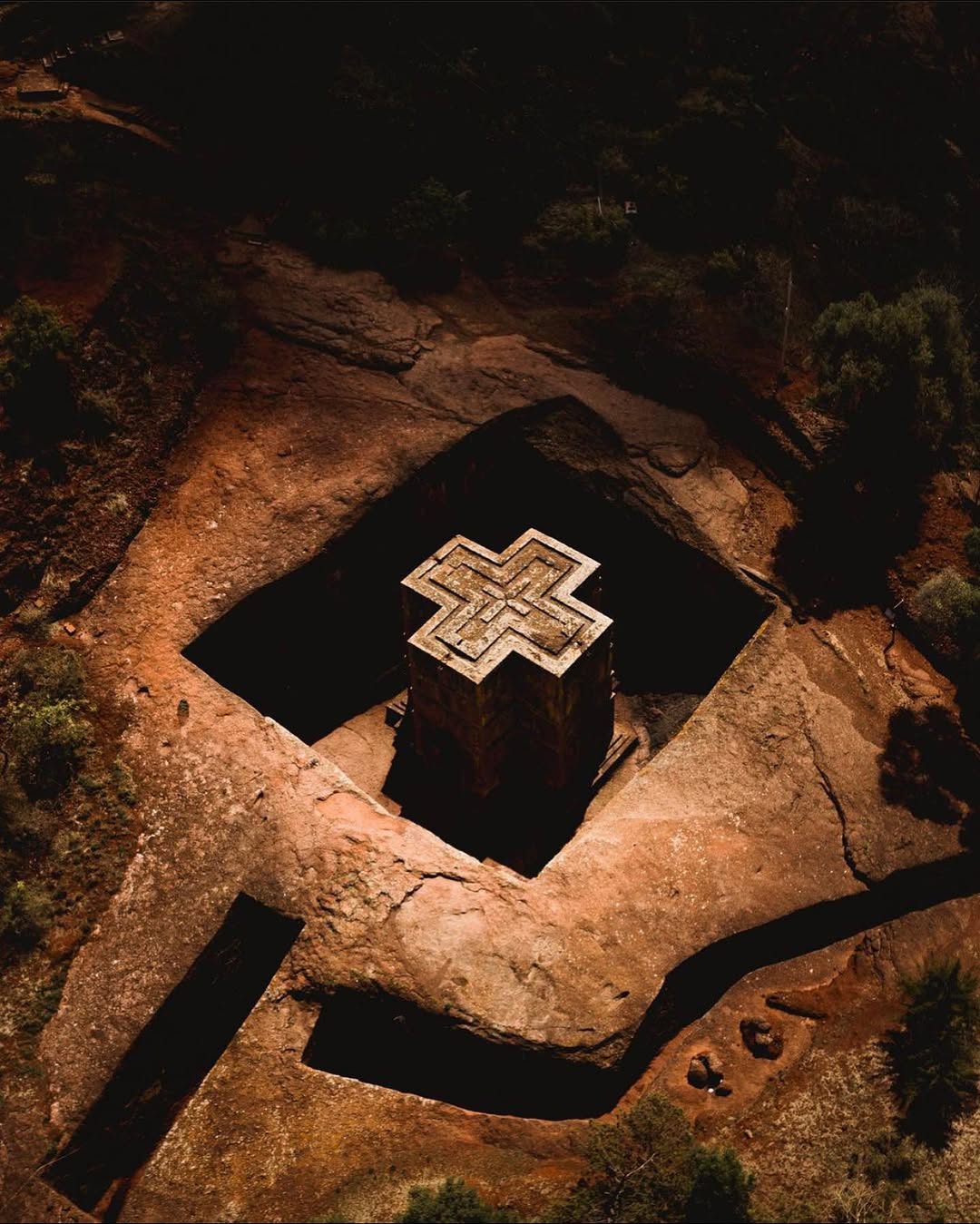
In the highlands of northern Ethiopia, at an elevation of roughly 8,200 feet, there are structures that exist in a category entirely their own. Not buildings. Not ruins. Not monuments in the conventional sense. Eleven churches stand here, each carved from a single, gigantic block of stone. No bricks, no mortar, no concrete, no lumber; just rock sculpted into architecture. They have endured for over 800 years and, on any given Sunday, they still fill with the sound of chanting priests. Most of what is written about Lalibela focuses on the wonder. But the deeper you go; geologically, historically, architecturally, the stranger and more profound it becomes.
The Stone Was Chosen, Not Found
Most accounts treat the rock as an incidental backdrop; something that happened to be there. But the northern highlands of Ethiopia rose 31 million years ago when fissures in the earth flooded the Horn of Africa with lava a mile deep. What this created, over millions of years, was a very specific kind of stone: volcanic tuff, or scoriaceous basalt; porous, gas-riddled, iron-red.
The volcanic tuff at Lalibela is relatively soft when first exposed to air, allowing it to be carved with hand tools such as iron chisels and picks. After exposure, the rock hardens, providing structural durability. This is the detail that almost no popular account dwells on long enough: the builders weren’t just lucky to find soft rock. They were exploiting a geological transformation window; a narrow, time-sensitive opportunity in which stone behaves almost like wood before permanently curing into something closer to concrete.

The geological units are composed of alternating massive and scoriaceous basalts. The main scoriaceous basalt level, embedded within the massive basalts, is 30–40 meters thick and corresponds to the horizon within which all the monuments of Lalibela have been carved. In other words, the builders identified a specific geological band within the mountain; a layer soft enough to sculpt but thick enough to work and placed every church within it. This was geological literacy of a high order.
They Invented Reverse Architecture
Every tradition of great building humanity has ever produced involves addition: stacking, placing, assembling. Lalibela inverted this entirely. At Lalibela, builders didn’t stack materials; they removed them, releasing complete buildings, roofs, walls, windows, vaults, even gutters from the bedrock itself.

The implications of this are more radical than they first appear. In conventional construction, a mistake can be corrected; a misplaced stone can be reset, a wall torn down. Here, the work had to proceed from the top down, meaning that errors in the upper portions could not be corrected without starting over. Every column, every arch, every window recess had to be conceptualized in full before a single decisive strike of the chisel. The builders were not constructing toward a vision. They were liberating it from within the mountain and they could not go back.
The craftsmen exploited natural horizontal bedding and variable hardness to sequence cuts, leave sacrificial margins where stone was weaker, and dress faces where the stone was sound. Reading the rock’s natural grain, the way a sculptor reads the grain of marble, was itself an engineering science, one that left no manual, no blueprint, and almost no trace of how it was taught or transmitted.
The Missing Stone Problem Nobody Has Solved
Here is perhaps the most glaring mystery that passes almost unremarked in popular coverage: the excavated material is gone. The massive amount of stone and earth that would have had to be removed from around the churches and from their hollowed-out interiors was nowhere to be found.

Think through the arithmetic. The largest church, Bete Medhane Alem, stands at a height of 10 meters and is 33 meters long and 22 meters wide. Now multiply that volume across eleven churches, their surrounding trenches, the tunnels connecting them, and the drainage channels carved into the plateau. The figure runs into hundreds of thousands of tons of rock. It vanished. No spoil heaps, no dumping ground, no quarry debris field has ever been identified near the site.
Where did it go? One possibility: it was transported far enough from the site to be archaeologically invisible. Another: it was reused; crushed and spread though there is no evidence of this either. The silence around this question is itself telling. Either the builders had a logistical operation of extraordinary scale and discipline, or the timeline of construction was far longer than tradition suggests, allowing gradual dispersal. Neither explanation is satisfying. The stone remains missing.
These Churches Are Older Than You Think And May Have Been Something Else
The standard story assigns the churches entirely to King Gebre Meskel Lalibela, who ruled from approximately 1181 to 1221 AD. But this is now seriously contested by archaeology. David Phillipson, professor of African archaeology at Cambridge University, has proposed that the churches of Merkorios, Gabriel-Rufael, and Danagel were initially carved out of the rock half a millennium earlier, as fortifications or other palace structures in the waning days of the Axumite Kingdom.

Phillipson argues that the oldest of the rock-hewn features at Lalibela may date to the 7th or 8th century. This would mean that what King Lalibela actually did was inherit existing rock-cut structures; possibly military or civic in function and transform them into sacred spaces. During the 13th century, Lalibela moved to the site and engaged in an energetic assumption of power by transforming some buildings into churches and carving out new ones.
French archaeological excavations at the site have reinforced this. Excavation of the rubble revealed that it was sitting atop traces of older buildings, which were most probably meant to disappear in favor of churches. The leaders of the Lalibela Mission see this as additional proof of the existence of a powerful society around the 10th or 11th century, one capable of constructing imposing buildings comparable to fortresses.
The political dimension of this is explosive but rarely discussed: the Solomonic emperors who succeeded the Zagwe dynasty branded them as usurpers, which fed into debate about who should be credited with excavating the churches. In other words, the historical record of Lalibela’s construction was shaped and perhaps distorted by the winners of a political succession struggle. What we believe about who built what may be, in part, dynasty-approved mythology.
The Hydrology Was an Engineering Marvel in Itself

Lalibela sits on a highland plateau that receives intense seasonal rainfall. Excavating church complexes deep into the ground and then keeping them from flooding for eight centuries required water management that rivals anything built in the medieval world.
A network of channels and trenches carved into the surrounding rock directs highland rainfall away from the church interiors. These systems still function after eight centuries without modern maintenance. The roofs of the four freestanding monolithic churches slope at the same angle as the rocks from which they were carved, further promoting drainage.
But the system went further than mere runoff management. A whole system of canals, trenches, cisterns, sluice gates, dams, catch basins, and other devices was created to both bring water into the area from an aquifer that was miles away and to manage all the rain and runoff during the rainy season. This includes the creation of multiple pools that were used for drinking water, baptisms, and healing and cleansing rituals.
This is a complete urban water infrastructure, carved entirely from stone, still operational. No pipes. No pumps. Just gravity, geometry, and an intimate understanding of how water moves across volcanic highland terrain.
The Buildings Were Acoustically Designed
One dimension of Lalibela’s genius that almost no visitor considers is what happens when the priests sing. These acoustic features were not accidental; they were engineered to elevate spiritual immersion. Geometry plus material equals instrument. The building itself is tuned; with no add-on technology required.

Volcanic tuff does not merely absorb sound; its porosity and density create specific resonance properties. The tunnel networks connecting the churches act as channels that distribute and amplify ceremonial sound across the complex. The churches that are carved as basilicas, with multiple aisles and columns, create reverberation patterns that make chanting swell and bloom in ways that open-air or timber-built structures cannot replicate.
There are no written records that the builders consciously designed for acoustics. But the Ethiopian Orthodox liturgical tradition, which is among the most musically elaborate of any Christian church in the world, had been practiced in stone-hewn spaces for centuries before Lalibela. The acoustic intelligence almost certainly accumulated, it was not invented but refined, generation after generation, by priests who knew how the stone responded to their voices.
A Pillar That Knows the Whole Story And No One Can Read It
Inside Bet Maryam, believed to be the first church carved, there stands one of Lalibela’s greatest mysteries: a sacred pillar said to be inscribed in two languages, telling the story of the city’s construction. The pillar is covered in cloth. Priests maintain that the inscription contains a full account of how the churches were built; the plans, the sequence, perhaps the workforce. The cloth has not been removed for examination.

This is not a conspiracy. It is a living religious tradition in which certain sacred objects are not meant for scholarly investigation. But it means that the single artifact most likely to answer the core archaeological questions about Lalibela remains deliberately concealed; not lost, not destroyed, but present and inaccessible by sacred choice. The answer to how these churches were built may be written on a pillar inside one of them. And it is wrapped in cloth.
The Churches Are Being Threatened By Admiration
For centuries, the primary threats to Lalibela were geological: water infiltration, rock fractures, the slow weathering of soft volcanic tuff. Major problems currently affecting the churches include discontinuities such as cracks, fissures, and joints, weathering and alteration, and human impact due to uncontrolled urbanization and unwise restoration works.

But the modern threat is more complex. Encroachment on the environment of the churches by new public and private construction, housing associated with the traditional village, and the infrastructure of tourism now press against a site that was engineered as a self-contained carved city. Every concrete foundation sunk near Lalibela alters the drainage patterns the medieval builders spent decades designing. Every careless conservation intervention threatens the hardened surface skin of volcanic tuff that protects the softer stone beneath.
Conservation interventions that restrict access during services or alter acoustic properties of worship spaces meet resistance from clergy who have maintained the churches for centuries without international oversight. This is the central paradox: the people most qualified to preserve Lalibela are the ones who have done so continuously for 800 years, and they are sometimes the ones UNESCO-affiliated projects work around rather than with.
What Lalibela Actually Is
The conventional narrative frames Lalibela as a monument; a thing that was made and stands. But that is not what it is. The original function of the site as a pilgrimage place still persists and provides evidence of the continuity of social practices. The intangible heritages associated with church practices are still preserved. It’s not a museum; it’s an active religious site. Ethiopian Orthodox Christians continue to pray, chant, and worship within the stone walls, just as they have for centuries.


What the builders created, working downward into living rock over generations, was not a memorial to faith but a vessel for it. The stone was not shaped to impress. It was shaped to hold; to hold worship, to hold water, to hold the dead in tombs cut into its walls, to hold a community in its tunnels and courtyards through every century that followed. The fact that it still does all of these things is not incidental to Lalibela’s greatness. It is the entire point.
The eighth wonder of the world is not a ruin. It is open for service this Sunday.