
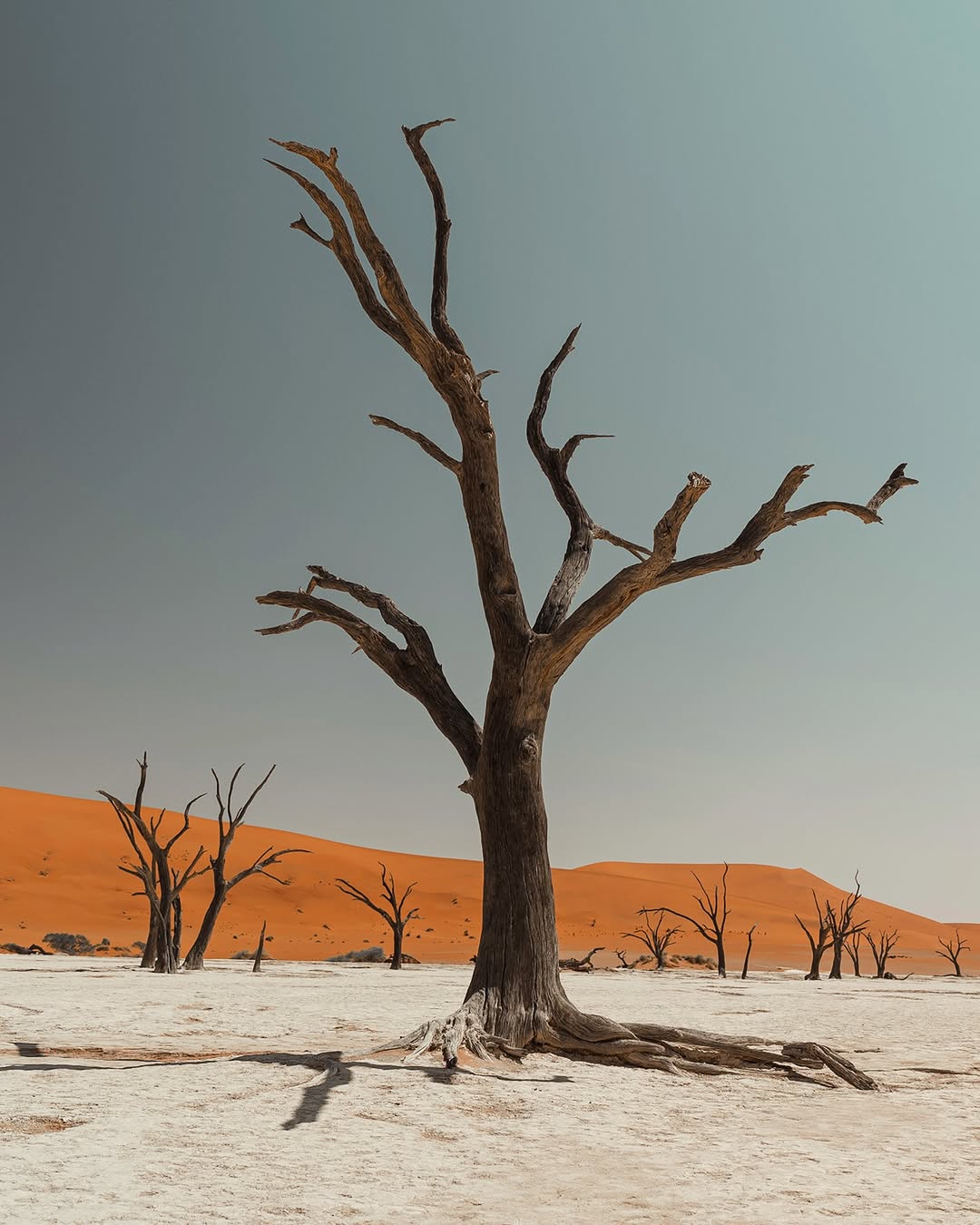
There is a place in southern Africa where time broke. Not slowed but broke. Where trees that died before Columbus was born still stand in the same pose they assumed in their final moments, neither rotting nor fossilizing, simply “waiting” in a kind of suspended fury. This is Deadvlei, a white clay pan tucked inside Namibia’s Namib Desert, and it is one of the most philosophically disorienting places a human being can stand on this planet.
Most accounts of Deadvlei tell you what it looks like. Very few tell you what it means.
The Place That Swallowed Its Own River

Deadvlei sits inside Namib-Naukluft Park in Namibia, its name translating literally to “dead marsh” or “dead valley,” positioned between towering dune peaks; some of which rival the height of the Empire State Building at around 1,312 feet. But the name is far more ironic than it first appears, because this was once the opposite of dead.
The pan itself formed approximately 5,000 years ago when the Tsauchab River deposited clay sediments in a floodplain. For millennia, it was a lush oasis; water in the middle of a desert, which in ecological terms is almost miraculous. The Tsauchab River flooded the region, creating temporary shallow pools where the abundance of water allowed camel thorn trees to grow.

Then, approximately 900 years ago, the desert made its move. The climate changed, drought hit the area, and sand dunes encroached on the pan, which blocked the river from the area. The trees were not burned by wildfire or felled by storms. They were simply cut off; isolated by their own landscape, left to exhaust whatever water remained in the clay beneath them, and then die standing.
What happened next is the part nobody talks about properly.
The Science of Standing Still

Here is the detail that should arrest every curious mind: the trees did not become petrified, which is where the organic materials of a tree are slowly replaced by minerals. Rather, the sun scorched the trees, rendering them as black as charcoal. The dryness of the area was such that the wood could not decompose because it was so dry. The trees of Deadvlei are desiccated rather than petrified.
This distinction matters enormously and is almost universally glossed over in popular coverage. Petrified wood is wood replaced by stone; it is “not” the original tree. What stands at Deadvlei is, in a very real sense, the actual wood of trees that were alive around 1100 AD. The carbon in those branches is the same carbon those trees pulled from the atmosphere during the reign of the Fatimid Caliphate. Nobody has made enough of this.

Deadvlei is one of the driest places on the planet: average annual rainfall is less than 10 millimetres. For comparison, Moscow receives 700 mm, seventy times as much. In that near-total absence of moisture, the microbial machinery of decomposition; the bacteria, fungi, and insects that dismantle dead wood everywhere else on Earth, simply cannot operate. The arid climate prevented bacteria and fungi from breaking them down. So, they remain, standing as they were centuries ago, a testament to the relentless march of time and the unforgiving nature of the desert.
What Deadvlei has achieved, entirely by accident, is what some of the most expensive preservation laboratories on Earth aspire to: the halting of biological time.
What the Colour Is Actually Telling You

Visitors photograph Deadvlei for its drama; the black trees against white clay against orange dunes against blue sky. Four colours. Four elements. Each one explained by a separate chapter of geological history.
The orange of the dunes is rust. Over thousands of years, the sand has literally rusted; iron oxide coating each grain, the dunes aging like exposed metal left in the wind. The white of the clay pan comes from high levels of kaolin, a type of white clay mineral, baked further by the intense desert sun. The blackness of the trees is not paint or ash but solar scorching; the sun has been working on those trunks for nine centuries, charring them the way slow heat chars wood from the outside in. And the blue of the sky exists because Deadvlei has virtually no atmospheric moisture to scatter light differently; it is one of the clearest skies on the planet.
Every colour in that photograph is a timestamp. You are looking at geological time, climatic time, biological time, and atmospheric physics; all at once, framed in a single pan 400 metres across.
The Forest That Predates Its Own Country

Here is an angle almost no one raises: these trees were already ancient when the very concept of “Namibia” came into existence. The camelthorn acacias of Deadvlei died around 1100–1200 AD. Namibia as a nation was born in 1990. The trees predate the country that now preserves them by nearly 800 years.
They were standing when the San Bushmen; who have inhabited this desert for tens of thousands of years, walked these corridors between dunes. For the indigenous peoples of Namibia, such as the San Bushmen and the Nama people, the Namib Desert holds deep cultural significance and is imbued with stories and legends passed down through generations. For them, Deadvlei is more than just a desert; it’s a spot of high spiritual significance and strength. The trees they regard as powerful may have been alive in the memories of their ancestors’ ancestors.
The Namib Desert is believed to have formed around 55 million years ago. The dead forest at its heart is, by comparison, a newborn curiosity; a 900-year-old snapshot of a single climatic event inside a desert that has been reshaping itself for longer than most mammals have existed.
A Laboratory Hidden in Plain Sight
Deadvlei is routinely celebrated as a photographer’s paradise, and it is. But it is also something far more practically valuable that almost nobody in tourism circles mentions: a real-world laboratory for understanding what happens to organic material when decomposition is denied indefinitely.
Its significance extends beyond aesthetics; Deadvlei symbolizes resilience in extreme environments and serves as a key site for studying desertification and climate change impacts on ancient ecosystems. The Namib as a whole hosts extremophile organisms; life forms that have evolved to survive conditions that would kill almost everything else and understanding how they interact (or fail to interact) with the preserved wood of Deadvlei raises questions with implications far beyond Namibia.

The study of extremophiles is particularly important for astrobiology, as understanding how these organisms survive in harsh conditions on Earth may provide insights into the potential for extraterrestrial life on other planets and moons within our solar system. Deadvlei is, in this light, not just a graveyard but a kind of dry run for the kinds of preservation conditions scientists theorize might exist on Mars; where organic material, once dead, could hypothetically endure for geological timescales in the cold, dry, UV-blasted atmosphere.
The dead forest in the Namib is one of the best natural analogues on Earth for Martian preservation conditions. This is almost never discussed in its promotion.
The Dunes Are the Walls of a Tomb
One more dimension that deserves more attention: Deadvlei is physically enclosed. The juxtaposition of the lifeless trees against Big Daddy, the area’s tallest dune at 325 metres, creates an almost architectural experience. The dunes do not merely surround Deadvlei; they sealed it. When they blocked the Tsauchab River roughly nine centuries ago, they acted as a dam and a lid simultaneously. They created the drought that killed the trees, and then they created the enclosure that preserved the corpses.
It is perhaps the only place on Earth where the agent of destruction is also the mechanism of preservation. The dunes murdered the forest and then built it a cathedral.
Visiting Without Consuming

The delicate balance of this unique ecosystem requires responsible tourism practices to ensure the preservation of this natural wonder. Visitors are encouraged to admire the trees from a respectful distance and avoid any physical contact with the trees. This is not bureaucratic caution. The trees, though they appear solid and sculptural, are essentially dried husks; the interior wood long since having lost the structural chemistry that once made it resilient. A hand pressed too hard could begin an irreversible collapse that nine centuries of desert air could not.
Salsola shrubs and clumps of Nara melon stay alive by subsisting off of morning mists; in the surrounding areas, proof that life has not surrendered, merely retreated to the margins, surviving on dew while the bones of a forest stand in the middle of everything.
What Deadvlei Is Really About
Deadvlei gets promoted as a wonder of nature, a photographer’s dream, an otherworldly landscape. All of that is true. But the more you sit with what it actually represents, the more it becomes something else: an argument about impermanence, made entirely by things that refuse to be impermanent.
The trees could not survive. But they also could not disappear. Trapped between life and dissolution, they became something the natural world almost never produces; permanent witnesses. Not metaphorically. Literally. The wood standing there today was growing there when the medieval Islamic world was at its height. Those branches were photosynthesizing when the Aztec Empire was still a century from existing.

There is a peculiar kind of humility that comes from standing in front of something that has been dead longer than your civilization has existed and realizing it is still more permanent than you will ever be.
That is what Deadvlei is. And no photograph has ever quite captured it.
Deadvlei is located within Namib-Naukluft National Park, Namibia. Access to the clay pan requires a 4×4 vehicle or a park-operated shuttle from the 2×4 carpark, followed by a short walk over sand. Visit at sunrise for the full effect of the light on the dunes.*