
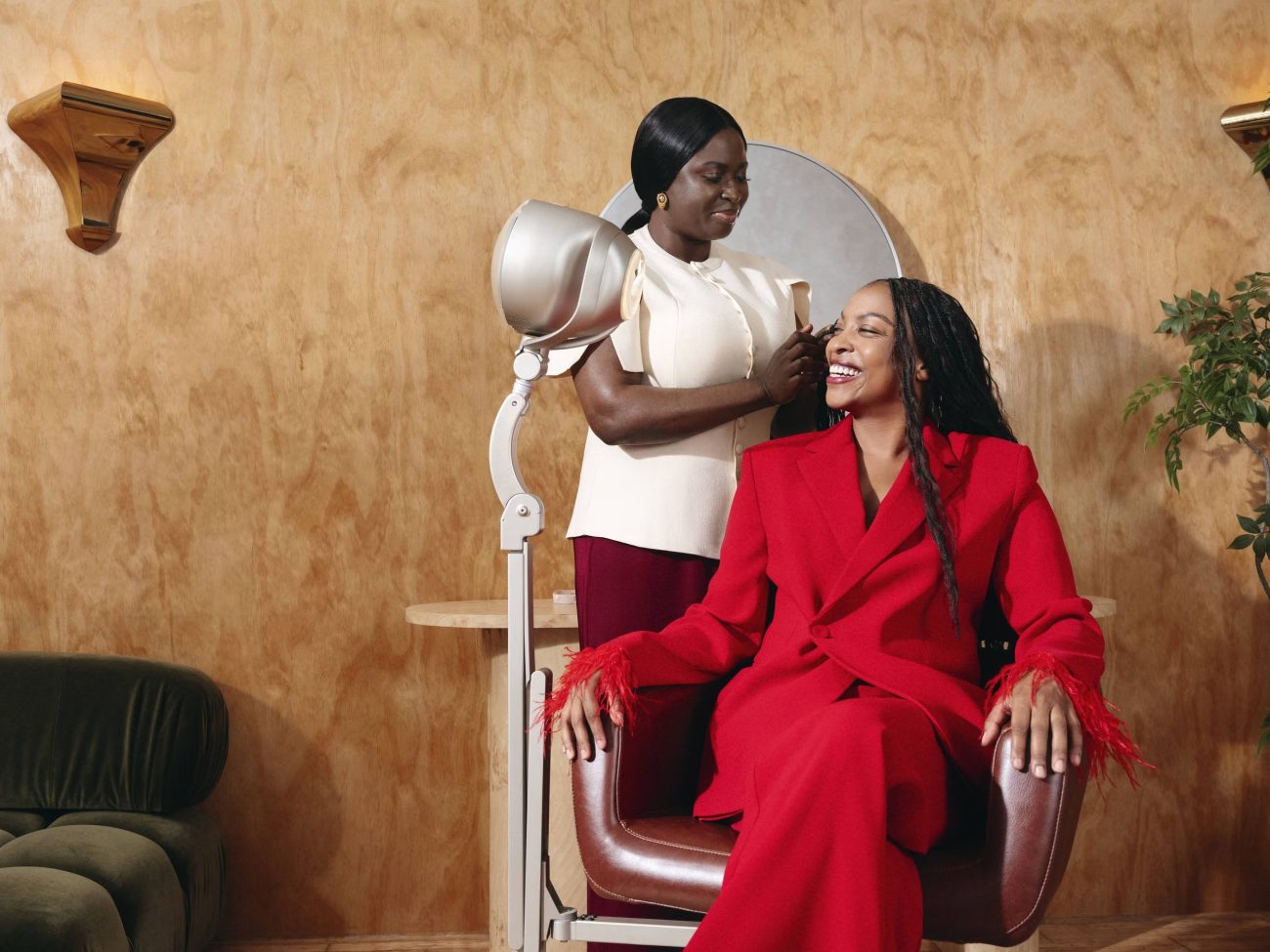
The Harvard-trained engineer and founder of Halo is bringing robotics into one of the most culturally significant beauty practices in the world. But beyond the promise of faster braiding lies a bigger conversation about Black beauty, the women who sustain the industry, and why textured hair deserves more technological investment.
For generations, hair braiding has been an expression of identity, heritage, creativity and community. Across Africa and the Black diaspora, it has carried meaning far beyond aesthetics. It is a skill passed between generations, a livelihood for millions of hairstylists and, for many women, an essential part of personal care.
Yet, despite the global popularity of braids, the process of creating them has remained largely manual. Hours spent sectioning, twisting and weaving hair are still part of the experience, whether in a neighbourhood salon in Lagos, a braiding studio in London or a beauty shop in the United States.

That is the problem Yinka Ogunbiyi wants to solve.
Ogunbiyi, a Harvard-trained engineer and entrepreneur, is the founder and chief executive of Halo, the technology company behind HaloBraid, a robotic braid-assist device designed to help professional hairstylists complete braids faster. In June 2026, the company announced $7 million in seed funding to advance the technology and prepare it for salon adoption.
But the significance of HaloBraid is not simply that a robot can braid hair. It is that someone has looked at a familiar, deeply rooted part of Black life and asked a question that the technology industry has been slow to consider: what if the everyday challenges of textured hair care were treated as serious engineering problems worth solving?
That question is what makes Ogunbiyi’s work worth paying attention to.
The Four Days That Started a Technology Company
The story of HaloBraid begins not in a robotics laboratory, but with a familiar experience for anyone who has spent hours getting their hair done.
Ogunbiyi grew up wearing braids, beginning at around five years old. Like many Black women, she understood the experience of sitting in a salon chair, watching television or chatting while a stylist worked through the hair, one braid at a time.
During the COVID-19 lockdown in 2020, when visiting a salon was no longer an option, she attempted to install her own waist-length knotless box braids. The process took four days.
For someone with a background in engineering, the experience revealed an opportunity. Braiding was not simply an artistic practice; it also involved repetitive mechanical movements that might be assisted by technology.
Ogunbiyi began asking why a process that had remained largely manual for centuries had not benefited from the same kind of technological thinking applied to other everyday tasks.
That question eventually became HaloBraid.
Her professional background made her well positioned to pursue the idea. Ogunbiyi holds a bachelor’s degree, a master’s degree in engineering and an MBA from Harvard University. Before founding Halo, she co-founded Desora, a smart cooking appliance company where she helped develop patented consumer hardware.
This is an important part of her story. HaloBraid is not simply a clever invention born from frustration. It is an example of what can happen when lived experience meets technical expertise, and when someone with the necessary skills decides that a familiar inconvenience deserves a serious solution.
What Is HaloBraid, and How Does the Hair-Braiding Robot Work?

First, it is worth understanding what HaloBraid actually does.
Although widely described as a hair-braiding robot, HaloBraid is more accurately a robotic assistant designed for professional hairstylists. It does not independently create an entire hairstyle from start to finish.
Instead, the stylist sections the hair, determines the size and pattern of each braid, incorporates the extensions and starts the braid by hand. The device then takes over the repetitive weaving stage, helping complete the braid before the stylist moves on to the next one.
According to Halo, the technology can finish individual braids up to five times faster than manual braiding. The company says its system is designed to work with different hair textures and braid sizes while reducing pulling and unnecessary tension. Actual time savings depend on the style and the stylist’s workflow.
There are still limitations. HaloBraid does not currently create cornrows or other styles braided directly against the scalp, and it does not independently add extensions. The stylist remains responsible for the foundational work and creative decisions.
That distinction matters because the real innovation is not the removal of the hairstylist. It is the automation of a specific, repetitive part of the process.
Developing a machine capable of manipulating something as delicate and unpredictable as human hair is also a significant engineering challenge. Hair differs in texture, density and behaviour, while braids require consistent movement and tension. Halo’s team reportedly developed more than 600 prototypes over three years before arriving at its current design.
The technology, therefore, represents more than a robot performing a familiar task. It demonstrates how engineering can be adapted to the complexities of textured hair.
What People May Be Missing About HaloBraid

The most interesting part of Ogunbiyi’s story is not necessarily the machine itself. It is what the machine reveals about the beauty industry, the people who work in it and the opportunities that emerge when overlooked needs receive attention.
1. Black beauty is not just a cultural category. It is an opportunity for technological innovation.
For years, conversations about Black hair have centred on products, trends, protective styling and representation in beauty campaigns. These are important, but there is another dimension that deserves equal attention: the technology used to care for textured hair.
Why should technological innovation stop at the products applied to hair? Why should it not extend to the tools, equipment and processes that make caring for it easier?
HaloBraid challenges that limitation.

Braiding is an ancient practice, but that does not mean every part of the process must remain unchanged. Traditions can preserve their cultural meaning while embracing tools that improve the experience of practising them.
Ogunbiyi’s work opens up a wider conversation about what the future of Black beauty technology could look like, from smarter salon equipment to tools designed around the specific needs of natural and textured hair.
Halo has explicitly stated that its ambitions extend beyond this first product, with a broader mission to develop technology that makes textured hair care faster, easier and more comfortable.
The opportunity is not to make Black beauty more like another beauty industry. It is to invest in the infrastructure that allows it to thrive on its own terms.
2. The hairstylist is just as important as the customer.
Much of the excitement around beauty technology focuses on the consumer. Will appointments become shorter? Will the service become more convenient? Will people have more time for their day?
HaloBraid invites us to consider the person on the other side of the chair.
Braiding demands sustained hand movements, concentration and physical endurance. For professional stylists who braid several clients a day, that repetitive work can contribute to strain and discomfort. Some stylists have reported concerns including carpal tunnel syndrome and arthritis in discussions with the HaloBraid team.

This makes the device’s potential benefits particularly meaningful.
If a stylist can complete the repetitive part of a braid more quickly, they may be able to serve more clients, reduce the length of their working day or create more room for other services. The outcome will depend on how each stylist chooses to organise their business.
The important point is that technology could help improve working conditions in a profession where physical effort is central to earning an income.
This is a more valuable measure of innovation than speed alone. A successful beauty technology should not only make life easier for the person paying for the service; it should also consider the person providing it.
3. Saving time could change the economics of the braiding business.
There is a business story here that deserves more attention.
Traditional braiding ties a stylist’s earning capacity closely to the number of hours they can work. Each appointment occupies time, and increasing the number of clients often means extending the working day.
That creates a difficult trade-off between earning more and preserving time for rest, family and personal life.
A tool that shortens the repetitive portion of the service could give stylists greater flexibility.
Some might use the additional capacity to accommodate more appointments. Others might choose to finish earlier or offer a more comfortable experience without increasing their workload. Salon owners could also explore different appointment schedules and service packages.
HaloBraid’s commercial model is designed around professional stylists rather than individual consumers purchasing the device for home use. Halo has described a model in which participating professionals pay a fee based on appointments where the technology is used, rather than buying the machine outright.
This is an interesting approach because it connects access to the device with its use in the business.
However, the long-term value will depend on the economics for individual stylists: how much time they actually save, how fees affect their earnings and whether clients benefit from more affordable or accessible appointments.
Those are important questions, but they do not diminish the opportunity. They show why the next stage of innovation must consider the business realities of the people it is designed to support.
4. The technology does not have to replace the cultural experience.
One of the most understandable questions surrounding a hair-braiding robot is whether automation could take something away from the experience.
Braiding is not always a silent, transactional service. Salon visits can be social occasions where people exchange stories, share advice, catch up with friends and build relationships with their hairstylists.
For many clients, the relationship with a trusted braider is part of the value of the appointment.

HaloBraid’s approach recognises that the mechanical work and the human experience are not the same thing. The stylist still creates the braid’s foundation, controls its design and remains responsible for the overall service. The technology assists with the repetitive weaving rather than taking over the entire appointment.
This is a useful way to think about automation more broadly.
Technology does not always need to eliminate human involvement to be transformative. Sometimes, its greatest value comes from removing a burden that prevents people from doing their best work.
The braider’s creativity, cultural knowledge, personal touch and relationship with the client can remain central to the experience.
In that sense, HaloBraid presents an opportunity to preserve what people value about braiding while rethinking what they have traditionally had to endure to enjoy it.
5. One of the biggest innovations is that someone finally took the problem seriously.
Perhaps the most significant aspect of Ogunbiyi’s work is the question behind it.
For years, long braiding appointments have been treated as an unavoidable part of getting the hairstyle. The time commitment is familiar, so it has often been accepted as something that simply comes with the process.
But familiarity does not mean a problem is beyond improvement.
Ogunbiyi’s experience demonstrates the importance of recognising opportunities within everyday life. She did not begin with an abstract search for a problem that could be solved with robotics. She encountered an inconvenience that she understood personally and investigated whether her engineering background could help address it.

Her team then developed prototypes and sought input from professional stylists, allowing the needs of the people who would use the device to influence its design.
That process offers a broader lesson for entrepreneurs: some of the most valuable ideas emerge when people stop overlooking the difficulties that others have learned to tolerate.
The opportunity is not limited to hair care. It extends to industries where skilled professionals perform repetitive work, where customers have accepted unnecessary inconvenience and where everyday challenges have yet to attract meaningful technological investment.
Ogunbiyi’s story is a reminder that innovation can begin with something as ordinary as asking why a familiar task still takes so much time.
Why Her Story Matters Beyond the United States
For African audiences, Ogunbiyi’s work carries an additional significance.
Hair braiding has deep roots across African societies, with styles, techniques and meanings that vary between communities. It is an art form, a profession and an important part of a global industry shaped by African and Black creativity.
Yet there is considerable room to develop more technology around the practical needs of the people who sustain that industry.
HaloBraid presents an opportunity to think about what that future might look like. Could similar innovation support African salon owners? Could technology help independent braiders manage demanding schedules? What would adoption look like in markets where salon pricing, electricity, equipment maintenance and business models differ from those in the United States?
These are possibilities rather than established outcomes. Halo’s initial rollout has focused on professional stylists and salons, and its wider international reach will depend on the company’s expansion plans.
Still, the questions are worth asking now.
Africa should not be viewed only as a source of cultural inspiration for the global beauty industry. Its professionals, entrepreneurs, engineers and consumers also deserve to participate in shaping the tools and technologies that serve that industry.
Ogunbiyi’s work offers a positive example of how cultural familiarity and technical expertise can come together to create a product with global relevance.
It also provides a reason to pay closer attention to the African and diaspora founders building solutions around needs they understand firsthand.
The Next Chapter for Yinka Ogunbiyi and HaloBraid
In June 2026, Halo announced a $7 million seed funding round led by Seven Seven Six, the venture capital firm founded by Reddit co-founder Alexis Ohanian, with participation from AlleyCorp and Bling Capital. The funding is intended to support product development, manufacturing readiness and partnerships with salons.
The investment is significant because bringing a new piece of salon technology to market involves more than building a working prototype. The company must establish reliable production, train professionals, gather feedback and demonstrate that the device delivers value in real appointments.
HaloBraid’s initial limitations also leave room for further development. Expanding the range of supported styles and improving the overall braiding workflow could create opportunities for future products.
The company has already discussed a broader vision for textured hair technology, including exploring ways to make braid removal easier.
There is much to learn as the product reaches more salons. Its long-term impact will depend on the quality of the results, the experience of stylists and clients, and the extent to which the business model remains worthwhile for participating professionals.
But the ambition is compelling.
Ogunbiyi is not asking people to abandon a tradition. She is asking them to consider whether the experience surrounding that tradition can be improved.
And that is a distinction worth making.
More Than a Hair-Braiding Robot

The temptation is to frame HaloBraid as a story about a robot entering a beauty salon. It is an appealing headline, but it does not fully capture what Ogunbiyi is building.
This is a story about a founder recognising an overlooked problem, applying engineering to an industry she knows personally and creating a tool intended to give skilled professionals more control over their time.
It is also a story about the future of Black beauty, where innovation can extend beyond new products and trends to include the technology that supports the people who make the industry possible.
The most promising outcome would not simply be shorter braiding appointments. It would be an industry in which stylists can work more sustainably, clients can access services more conveniently and technological investment reaches the needs of textured hair with greater purpose.
Ogunbiyi’s achievement is not that a machine can reproduce a human movement. It is that she recognised an opportunity to use technology in service of a skill, a profession and a cultural practice that millions of people value.
And perhaps that is the bigger lesson of HaloBraid: some of the most meaningful innovations do not begin by asking what technology can replace. They begin by asking what technology can make better.