
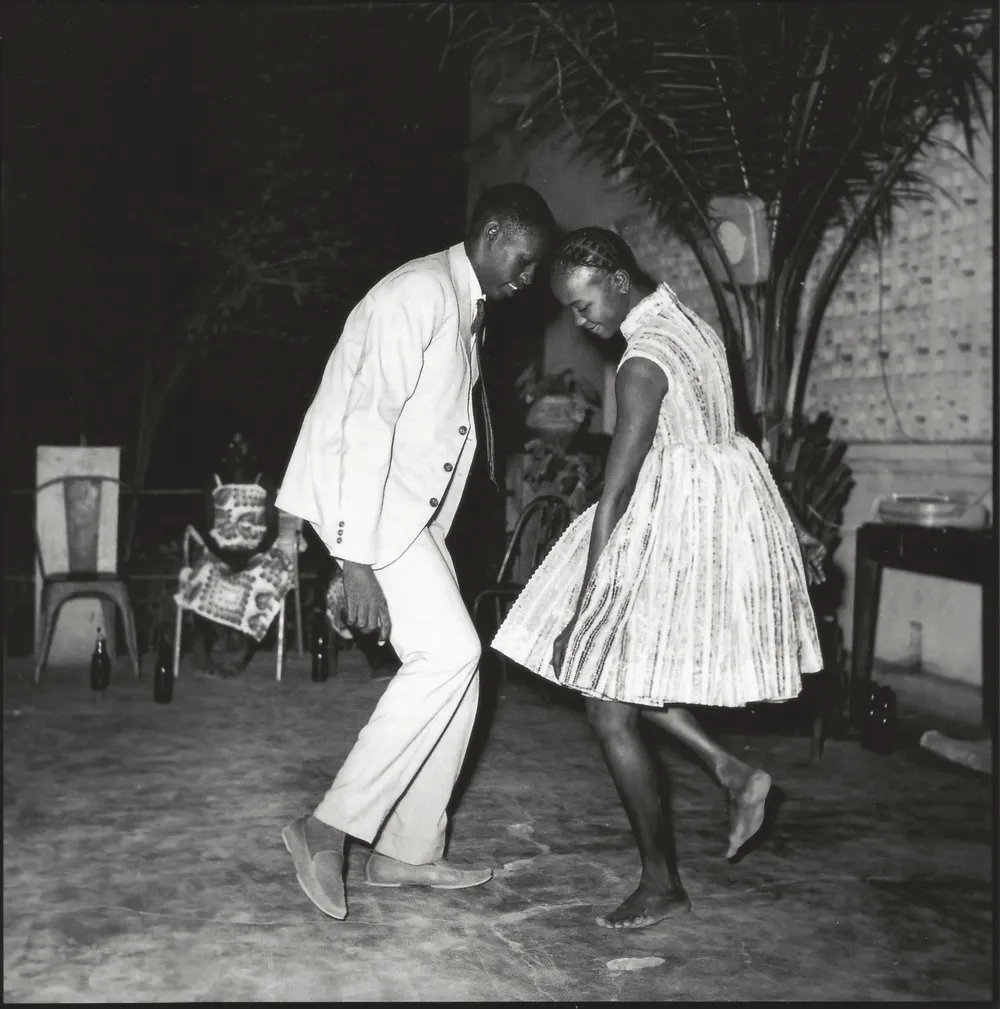
For most of the twentieth century, the dominant photographic record of Africa was made by outsiders; colonial administrators, missionaries, anthropologists, and later, foreign photojournalists and it told one story on repeat: famine, war, poverty, the “untouched” tribe, the continent as subject rather than author. But running alongside that record, and largely invisible to the audiences who consumed it, was another one entirely: a body of work made by Africans, for Africans, about the ordinary business of being modern, stylish, political, desired, and alive.
This is the story of the photographers who built that second archive and, just as importantly, of the parts of that story that rarely make it into the retrospectives.
The studio as a stage for self-invention
Long before “self-fashioning” became an art-world buzzword, it was Saturday-afternoon business in Bamako, Dakar, and Accra. In cities across West Africa from the 1940s through the 1970s, portrait studios became engines of a new kind of image-making; one where the sitter, not the photographer, controlled the story.

Seydou Keïta opened his studio in Bamako in 1948, on land his father had given him, and for the next decade he photographed the city’s traders, civil servants, and rising middle class. He kept a wardrobe of European suits, watches, radios, and even a scooter for clients to pose with, blending it with their own wrappers and jewelry however they liked. Word of his eye for composition and elegance spread across the region, and his studio became a landmark in its own right. But the portraits weren’t neutral documentation; they were collaborations in self-presentation, made for a client’s own family album rather than any outside audience.

Malick Sidibé, working a decade behind him out of Studio Malick in the Bagadadji neighborhood, turned his camera toward Mali’s newly independent youth: nightclub dance floors, sporting events, and parties full of young people testing out new political and personal freedoms in a country only recently free of French rule. Curators now describe Keïta and Sidibé’s combined body of work plainly as Africans controlling the camera to create images of African subjects for an African audience, with the studio functioning as a kind of theater in which sitters coordinated their own costumes, props, and poses.
What tends to get flattened in the international retelling is that Keïta and Sidibé were not the beginning of this tradition; they were its most famous inheritors. Senegal’s studio-photography lineage reaches back to 1859. Mali’s own scene began later, in 1935, when a Frenchman named Pierre Garnier opened the country’s first studio and trained the local photographers; among them Mamadou Dembélé, who spent the next decade quietly building the craft before Sidibé ever picked up a camera. Malian photographer Hamidou Maïga, who began working in Timbuktu in the 1950s before opening his own Bamako studio in 1973, produced portraits every bit as confident and stylish as his more celebrated peers, arranging sitters against simple cloth backdrops and later elaborate painted scenery — yet he remains a footnote next to Keïta and Sidibé in most accounts of the era.
The women who were photographed and the ones who picked up the camera
Here is the part of the story that gets skipped most often: for every studio portrait of a well-dressed woman from mid-century West Africa, there is a strong chance the photographer was a man, and an even stronger chance that history never recorded whether a woman photographer existed in that same town at the same time.
Researchers who’ve gone looking for early African women photographers describe the search as strikingly difficult. One historian working with archival collectors has described it as remarkable that so little documentation of early African women photographers survives at all; beyond scattered footnotes, like a Nigerian studio owner from the early 1900s whose fate is entirely unknown. The imbalance runs deeper than simple absence. Colonial-era photography was, first and foremost, an instrument of empire, and African women were disproportionately its subjects; staged, costumed, and often eroticized for postcards sent home to Europe, while almost never being credited as the ones behind the camera.

Ghana offers one of the few exceptions with a documented name attached to it: Felicia Abban. Trained from age fourteen as her father’s only female apprentice, she became Ghana’s first female professional photographer and went on to work for the country’s first president, Kwame Nkrumah, through much of the 1960s. She opened her own studio in Jamestown, Accra, in 1955, took on other women as apprentices, and became known for portraits that later observers compared to fashion photography for their attention to style and self-presentation. She also photographed herself constantly, using self-portraits to advertise her studio; a rare instance of a woman inserting herself into a visual record that usually only looked at women rather than from behind their eyes. Even so, when Nkrumah was overthrown in a coup in 1966, Abban faced political persecution and temporarily gave up photography altogether; a reminder that access to the camera never fully insulated African image-makers, women especially, from the politics swirling around them.
The broader pattern is one that archivists and curators are still working to correct. A significant portion of what was photographed by early African pioneers has simply been lost, or is in the slow process of being lost; through poor storage, neglect, or studios that closed without anyone thinking to preserve their negatives. The result is a kind of double erasure: photographers who were never well represented in institutional archives to begin with, and whose stories have therefore never been properly written. For women, that erasure runs deeper still.
When the camera was an act of resistance
In apartheid South Africa, taking a photograph could get you arrested, beaten, or worse; which is precisely why the country produced some of the most fearless photojournalism on the continent. Drum magazine, founded in Johannesburg in 1951, built its reputation by sending young Black photographers into the townships, mine compounds, and prisons that the apartheid state wanted hidden from view.

The methods these photographers used to get their images rarely make it into gallery wall text. Drum’s photographers regularly had to invent tactful ruses just to avoid having their equipment confiscated or their film destroyed by white officials. In one especially bold operation, photographer Bob Gosani and writer Arthur Maimane posed as a white secretary’s assistants in order to smuggle out photographs exposing brutal conditions inside a South African prison farm. Peter Magubane, who started at Drum as a driver before becoming one of the era’s defining photojournalists, paid an almost unimaginable price for decades of that work: 586 days in solitary confinement in 1969, his home burned down in 1976, surviving being shot seventeen times below the waist at a funeral in 1985, and, in 1992, the murder of his own son in Soweto.

Ernest Cole‘s story is the one most often left half-told. His 1967 book House of Bondage was among the first photographic accounts of apartheid life to reach a global audience, and it cost him everything; its publication sent him into permanent exile and saw the book banned in his home country. What audiences rarely hear is what happened after: Cole spent his final decades in the United States, increasingly isolated and unable to work, and died in New York in 1990, homeless, believing his life’s archive had been lost for good. Then, in 2017, out of nowhere, a Swedish bank contacted his family to say that roughly 60,000 of his negatives; some from his South African years, tens of thousands more from his years in exile, had been sitting untouched in a Stockholm vault the entire time, tied to photographic institutions that had once been trusted with his work. No one has ever fully explained how they ended up there or why they were never returned while Cole was alive to see them. The filmmaker who later built a documentary around the discovery has said he suspects the negatives weren’t so much lost as quietly withheld; not unlike the way African art and artifacts have often been taken and never returned throughout history and that he deliberately kept the mystery of the vault on the margins of his film, because he wanted the story to center Cole’s own voice rather than the intrigue surrounding his estate.
The diaspora’s counter-image
Not every corrective to the “Africa we never saw” was made on the continent. Some of the most radical images came from photographers forced off it.

Rotimi Fani-Kayode was born into a Yoruba family in Lagos, exiled to England with his family after Nigeria’s civil war broke out in 1966. Working in London through the 1980s, against a near-total absence of images depicting Black gay desire, he built a body of work fusing Yoruba spiritual iconography; his family were traditionally keepers of a shrine to Yoruba deities in Ife; with unapologetically erotic, ritualized portraits of Black men. He described himself as an outsider on three counts at once: his sexuality, his geographic and cultural displacement, and his refusal of the respectably married professional life his family had expected of him. He died of an AIDS-related illness in 1989 at the age of thirty-four, having produced nearly all of his major work in under seven frantic, prolific years; a career cut short in a way that rarely gets mentioned in the same breath as the renewed popularity of his images today.

Samuel Fosso approached self-image from another angle entirely. Working out of a studio in the Central African Republic, Fosso built his reputation on self-portraits in which he adopts a rotating cast of personas; dictators, liberation icons, glamour models, imagined ancestors; turning the studio backdrop into a stage for restaging African political history through his own body, and often through cross-dressing and gender play that unsettled easy categorization. Where Fani-Kayode’s work insists on being read as queer, Fosso’s play with gender operates more obliquely, but both photographers shared a refusal of documentary “realism” as the only legitimate way to picture African life; a refusal that put them at odds, for years, with an art market that preferred its African photography to look anthropological rather than invented.
Ordinary life as an archive of its own

Perhaps the most quietly radical body of work in this history belongs to J.D. ‘Okhai Ojeikere, a Nigerian photographer who spent decades photographing something almost nobody thought was worth photographing: hair. Beginning in 1968, working without any commercial backing, Ojeikere set out to document Nigeria’s constantly evolving hairstyles as living evidence of a culture in the middle of postcolonial reinvention. He eventually amassed an archive of nearly a thousand images, taken at work, at parties, and on the streets of Lagos, photographing almost exclusively from behind so that the sculptural, architectural quality of each style; nicknamed for the shapes they mimicked, from pineapples to bridges; could stand as the true subject of the image. Most of his contemporaries treated the project as a curious sideline rather than serious art, which is exactly why it survives today as one of the only extended visual records of a vernacular art form that changed by the year and was never written down anywhere else.
What the record still owes
Taken together, these bodies of work amount to a rebuttal; not through polemic, but through sheer volume of ordinary, dignified, self-directed life, to the idea that Africa’s twentieth century was only ever a story of crisis. But the story of these photographers has its own blind spots, and they are worth naming rather than smoothing over: the women whose names never made it into any ledger; the photographers whose negatives were seized, sold abroad, or simply left to decay in un-climate-controlled studios while collectors overseas built retrospectives around the handful of archives that happened to survive; the queer and diasporic photographers who were, for decades, considered too far outside the documentary tradition to count as “African photography” at all; and a market that has often rewarded a narrow set of aesthetics; sharp black-and-white studio portraiture, mid-century nostalgia, while leaving harder, less exportable work under-collected and under-shown.
The Africa these photographers captured was never actually hidden. It was simply never the Africa most of the world was being shown.