
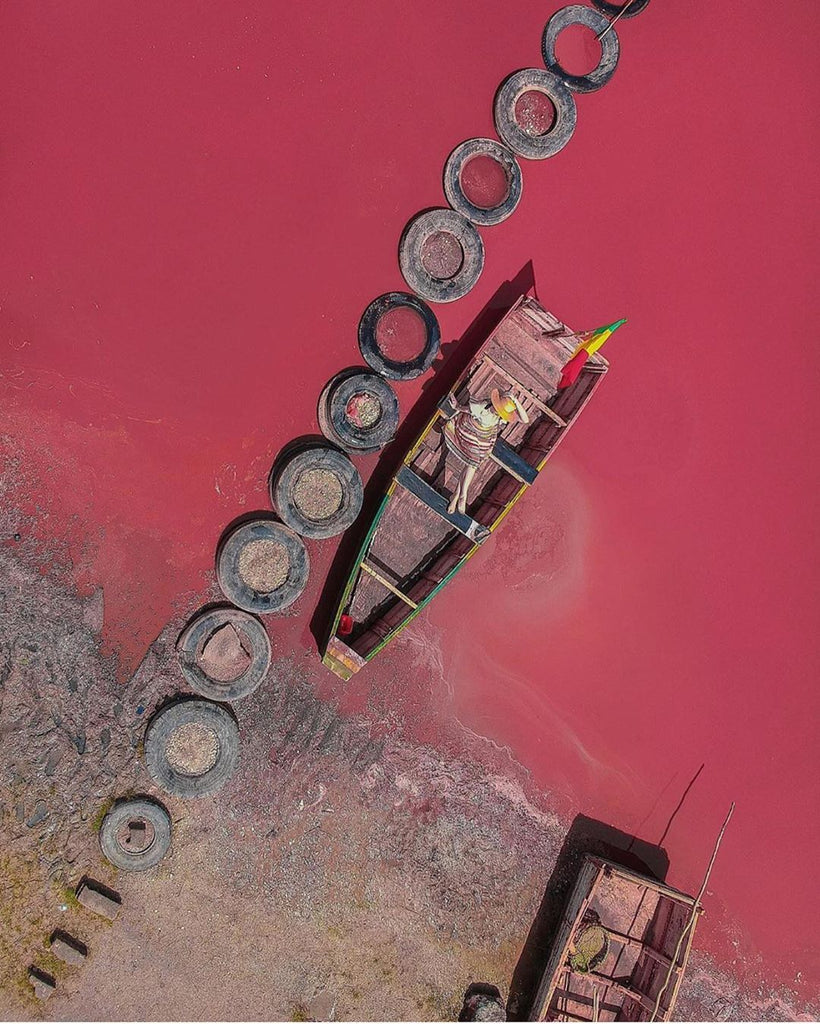
There are places that make you question whether you’ve slipped through some quiet fold in reality. Lake Retba or “Lac Rose” as the Senegalese call it, is one of them.
It sits just 35 kilometers northeast of Dakar, separated from the Atlantic Ocean by nothing more than a whisper of sand dunes, and it bleeds pink. Not the soft blush of a sunrise. A deep, saturated, strawberry-milkshake pink that deepens as the sun climbs and burns molten at golden hour.
Most people who’ve heard of it think they understand it. They’ve seen the photos. They know algae makes it pink. But Lake Retba is one of the most misread places in all of Africa; photographed a million times and still barely understood.
The Color Is Alive, Not Static

Here’s what almost every travel article glosses over: the pink isn’t constant. It’s most intense during the dry season between November and June, and fades when wet season rains dilute the salinity. But the variation goes far deeper than seasonal.
The algae responsible, “Dunaliella salina” produces a red pigment called astaxanthin, and this microbiological activity intensifies when the wind blows across the lake. The lake changes color almost hour by hour. The pale champagne rose at 7 AM is a completely different lake from the near-burgundy you’ll see at high noon. At dusk, it briefly becomes something that doesn’t seem to belong to this planet.
Here’s the insider tip nobody shares: just before midday, the shimmer turns to its deepest pink. Most tourists chase morning or golden-hour light. Show up at noon, when the heat feels unreasonable, and you’ll see the lake at its most surreal.
A Microbe That Defies What Life Is Supposed to Do
The salinity in Lake Retba reaches 380 grams per liter; higher than the Dead Sea, supporting unique extremophile life forms studied by scientists globally.
“Extremophile”; That word is worth pausing on. These are organisms that thrive precisely where life has no business existing. According to Michael Danson, a researcher specializing in extremophile bacteria at Bath University, “Dunaliella salina” produces a red pigment that absorbs sunlight to generate energy; which is exactly what turns the water pink.
Scientists studying the possibility of microbial life on Mars study organisms like this one, because the conditions here are analogs for what might exist on other hostile worlds. The “planet from another planet” feeling isn’t just poetic. It’s scientifically accurate.
The Human Story No Postcard Shows

The pink water is the backdrop. The people working in it are the real story.
Since the 1970s, nearly 3,000 families have been working the southern shore; men standing chest-deep, breaking salt from the lakebed with stakes and shovels, loading it into canoes, while women dry it in the sun until it turns white.
Men once fished this lake, but by the 1970s, in response to droughts and economic hardship, locals began harvesting salt to survive. What started as necessity became a generational identity.
Before entering the water each day, workers rub shea butter on their bodies to protect against the corrosive salinity. It’s an ancient, elegant solution; one African plant’s oil standing between a person and an inhospitable body of water. When you see the salt workers from the shore, they glisten. You might think it’s sweat. It’s something much older.
The salt preserved in this lake ends up in “thieboudienne”, Senegal’s beloved national dish of fish and rice and Senegal is the number-one salt producer in Africa. This modest, three-square-kilometer pink lake is quietly part of an entire continent’s food supply chain.
The Rally Scar You Can Still Feel

For decades, Lac Retba was the finish line of the legendary Paris-Dakar Rally; the point where drivers who had crossed the Sahara and survived Mauritania’s punishing terrain finally reached the end. A monument near the shore still commemorates it. The dunes surrounding the lake aren’t just scenic; they carry the mythology of one of the most grueling motorsport events ever conceived. You feel it when you take a quad bike across the ridgelines at sunset, the Atlantic glittering one way, the pink lake burning the other.
In 2022, severe flooding turned the lake green, destroyed $696,000 worth of salt mounds, and disrupted the lake’s unique microbiome. The pink has returned as of 2025, but the recovery is fragile.
There’s also an uncomfortable irony: the lake is vulnerable to contamination from chemicals in sunscreen and bug sprays. The tourists who come to see it may be quietly eroding the very conditions that produce the color. Wear reef-safe sunscreen, or skip it for your swim. The lake deserves that small consideration.
UNESCO is currently considering Lake Retba for World Heritage designation. When that happens, the nature of visiting will change; more infrastructure, more crowds, more management. Right now, it still belongs to the families who harvest it and the traveler curious enough to seek it out.
What It Actually Feels Like to Be There

You arrive expecting drama. What you get is something more disorienting. A narrow sand dune separates the lake from the Atlantic, so you can hear ocean waves while standing in what looks like a desert painting. The air is thick with salt. The ground crunches. Wooden boats bob in water the color of a Himalayan salt lamp.
And then you float. Like the Dead Sea, the salt concentration means you float effortlessly. Lying horizontal, unsinkable, pink water around you, open sky above; that’s the moment this place stops being a destination and becomes something that belongs to you personally.
Go during the dry season. Go at noon. Watch the workers at dawn when the mist is still on the water. Eat “thieboudienne” in the village of Niaga. Float until the sky and lake feel like the same pink thing.
This lake doesn’t need a filter. It just needs you to show up.
Best time to visit: November – June · Nearest city: Dakar, ~35–45 mins by road · Peak color: midday, direct sun